


To store your CBD flowers, keep them in an opaque, airtight glass jar. Maintain the humidity between 0.55 and 0.65% water activity using a moisture-regulating sachet, and protect the container from heat and light. Avoid grinding the flower before use and do not freeze it: both of these actions damage the trichomes and accelerate the loss of aroma.
In short:
- The ASTM D8197 standard sets the water activity between 0.55 and 0.65; a regulating sachet helps to maintain it, with control by hygrometer.
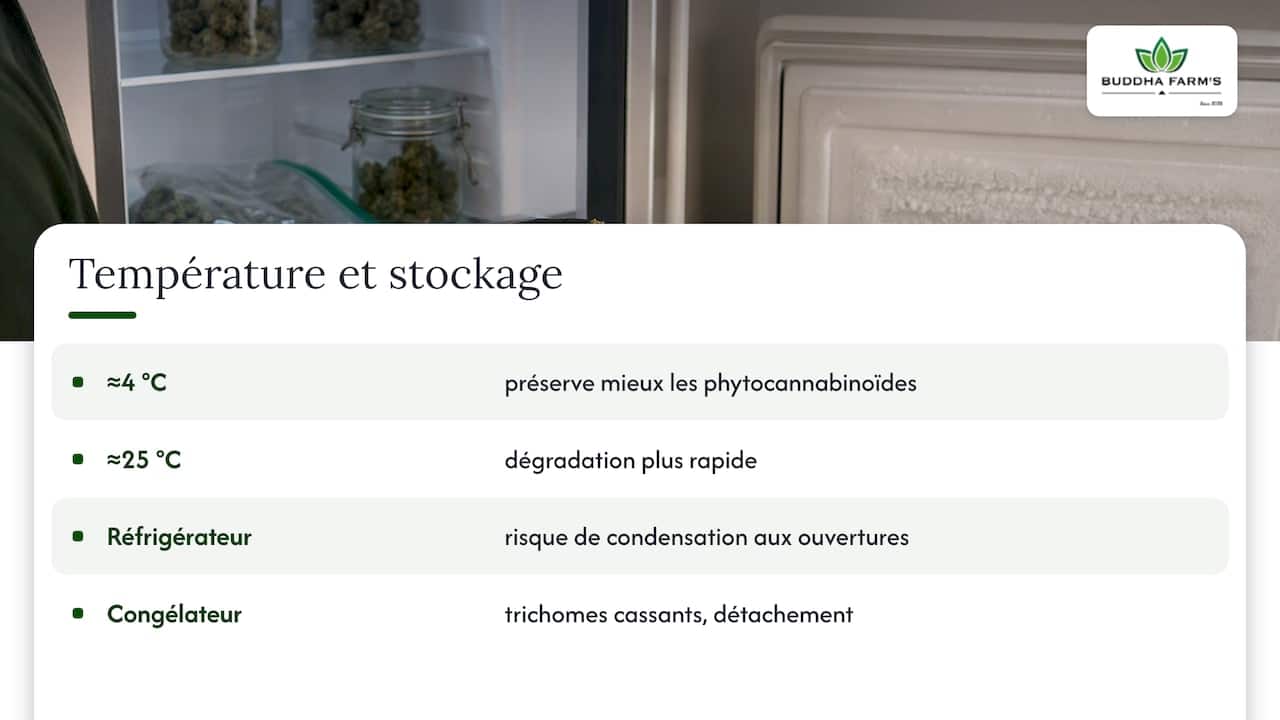
- One study indicates that storage at around 4°C preserves phytocannabinoids better than at 25°C, but each time the refrigerator is opened, condensation can occur.
- An opaque jar the right size for the batch limits air and light; keep the flowers whole until you're ready to crush them.
- A weak odor or brittle heads indicate a loss of quality; any white or grey fuzzy spot means the batch should be discarded.
Table of Contents
- Good practices: containers, light, oxygen and handling
- Humidity control: understanding aw, hygrometers, and regulating sachets
- Temperature and storage: recommendations and pitfalls to avoid
- Preserving terpenes and aroma: what recent studies show
- Shelf life: how long and what signs to watch for
- A handy checklist for maintaining a daily portion
- What in-store experience teaches us about preservation
- Our solutions for properly storing your CBD flowers
- Frequently Asked Questions
- Sources
Good practices: containers, light, oxygen and handling
The container makes all the difference. An airtight glass jar protects the flower from the ambient air, unlike flexible plastic bags that allow moisture and odors to pass through. When the glass is tinted or opaque, it also blocks UV rays that degrade cannabinoids and cause the buds to fade in color.
Oxygen remains the other hidden enemy. The more air there is in the jar, the faster the aromatic molecules evaporate. It is therefore better to choose a container the right size for the batch, rather than a large, half-empty jar. A study on drying and post-harvest packaging confirms that post-harvest processing directly influences the amount of volatile compounds retained in the dried flower.
The handling is just as important as the container itself:
- Fill the jar without packing the flower down, so as not to break the trichomes.
- Avoid thin plastic bags or boxes with non-airtight lids.
- Never leave the jar open for more than a few seconds.
- Never crush the flower before the day you consume it.
This last point deserves particular attention. A whole flower physically protects its trichome layer, whereas a ground flower immediately exposes a much larger surface area to the air. If you're looking to prepare a portion without damaging it, our page on grinders and preparation accessories details how to measure just before consumption.
Humidity control: understanding aw, hygrometers, and regulating sachets
Water activity, denoted aw, measures the amount of water available in the flower for chemical reactions and microbial growth. It's not the same as conventional humidity, but it's the indicator professionals use.
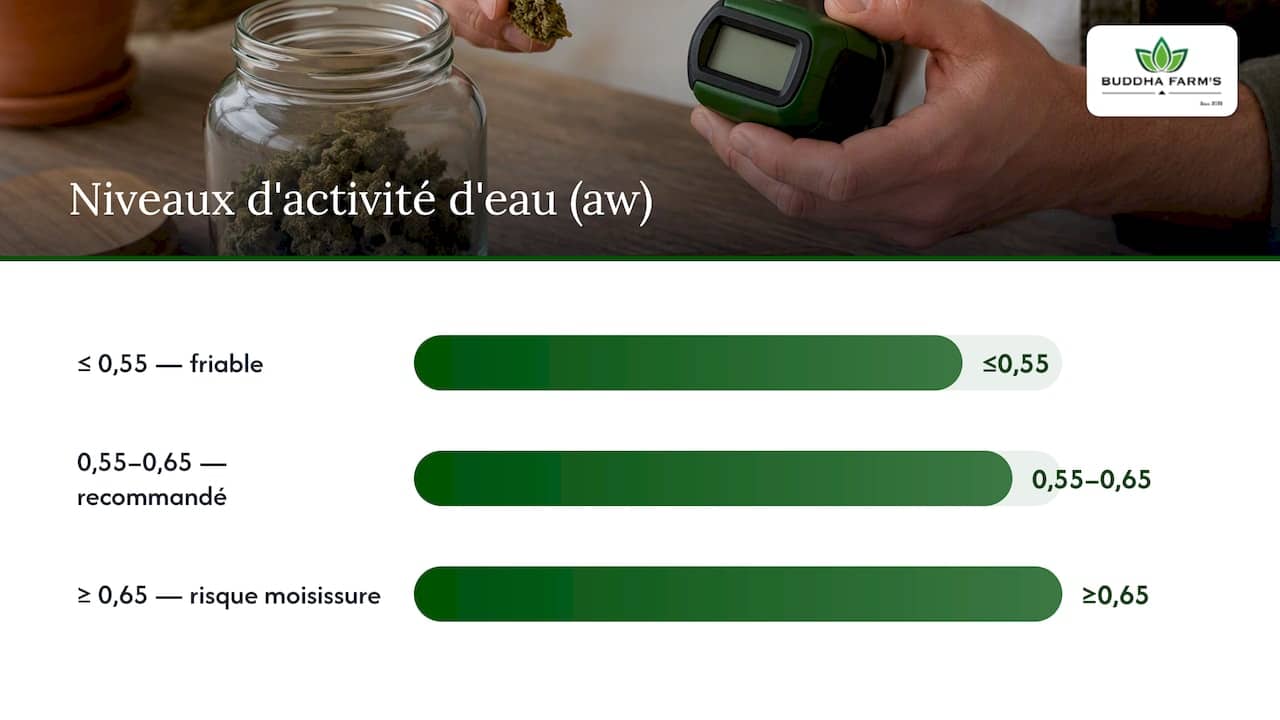
The ASTM D8197 recommends a water activity (aw) range of 0.55 to 0.65 for dried cannabis flower. Below 0.55, the flower becomes brittle and loses its terpenes more quickly. Above 0.65, the risk of mold increases significantly.
To stay within this range without expensive equipment:
- Use a salt-based humidity regulator sachet, placed directly in the jar.
- Check the level with a pocket hygrometer once a week at first, then once a month once stability is reached.
- Replace the sachet as soon as it becomes hard or crystallized, a sign that it has reached its absorption limit.
Temperature and storage: recommendations and pitfalls to avoid
Heat accelerates all degradation reactions. A study on post-harvest storage conditions shows that storage at around 4 degrees Celsius preserves phytocannabinoid composition better than storage at room temperature around 25 degrees. A cool cupboard, away from a heat source or window, is therefore preferable to a shelf exposed to sunlight.
The refrigerator isn't the miracle solution you might think. Each opening creates a thermal shock that encourages condensation inside the jar, creating an ideal breeding ground for mold. The freezer presents a different problem: the extreme cold makes the trichomes brittle, and they detach at the slightest touch. If you still opt for refrigerated storage, limit openings and keep the jar perfectly airtight each time you take it out.
Preserving terpenes and aroma: what recent studies show
Terpenes are the most fragile molecules in the flower. Volatile by nature, they evaporate as soon as they are exposed to light, heat, or open air. This is why darkness and a tightly sealed container are more important than any other detail.
Research on compartmentalized packaging shows that it is possible, in the laboratory, to maintain or even partially recreate the terpene profile of a flower using specific packaging systems. These techniques remain primarily useful to producers and processors, not to the average consumer.
For home use, the combination of an opaque glass jar and a humidity-regulating sachet remains the simplest and most accessible solution:
- Always keep the jar away from light, even indirect light.
- Never transfer the flower into a non-airtight bag for transport.
Pro tip: beware of products that promise a boost in aroma thanks to added oils: they often mask an already degraded flower rather than preserve it.
Shelf life: how long and what signs to watch for
Under optimal conditions, a CBD flower retains most of its aromatic qualities for several months. After this period, the loss of terpenes becomes noticeable, even though residual cannabinoids remain present for longer.
There are a few signs that should alert you: for bulk storage or a professional solution, also check out the options from CBD Flower Trim Wholesale.
- A faint or almost absent odor, a sign that the terpenes have evaporated.
- Buds that crumble at the slightest touch, too dry to be enjoyable.
- White or grey, fuzzy spots indicate mold: in this case, throw away the batch without hesitation.
A simple trick to avoid unpleasant surprises: portion your flowers into small jars and write the packaging date on each one. This way, you avoid constantly opening the same container and you always know which batch to use first.
A handy checklist for maintaining a daily portion
- Never crush the flower before you are ready to consume it.
- Choose an opaque glass jar, the size of which is appropriate for the batch you are storing.
- Place a humidity-regulating sachet and check the aw with a pocket hygrometer.
- Label the jar with the packaging date and store it away from light and heat.
Check the regulator sachet weekly at first, then space out the checks once stability is achieved, and clean the jar with hot water without perfumed soap between batches.
What in-store experience teaches us about preservation
In stores, the most common mistake is grinding the flower beforehand: customers prepare their flower in advance and lose most of its aroma within a few days. Each batch is selected for its traceability and freshness, but home storage remains your responsibility. To learn more, our comprehensive guide to CBD flowers details the terpene profiles of different varieties.
— Fred
Our solutions for properly storing your CBD flowers
Proper preservation often starts with the right equipment. Rather than improvising with a freezer bag, we offer a selection of accessories designed for this purpose: glass jars, humidity control bags and pocket hygrometers, available on our accessories.

If you're starting from scratch, our CBD flower includes batches from indoor, greenhouse, and outdoor cultivation, selected for their traceability and compliance with French legislation. To delve deeper into the subject before buying, our ultimate guide to CBD flowers covers everything from choosing strains to proper storage.
Personalized advice on suitable equipment is available, whether you are storing a small batch or a reserve for several months:
- Opaque glass jars of various sizes.
- Humidity regulating sachets with multiple aw thresholds.
- Pocket hygrometers for precise monitoring.
Frequently Asked Questions
How long can CBD flowers be stored?
Under good storage conditions, a CBD flower retains most of its aromatic qualities for several months. After this period, the terpenes gradually evaporate and the smell becomes more subtle, even though the cannabinoids remain present.
Should CBD flowers be refrigerated?
Refrigeration is not recommended for regular use, as each opening creates condensation that promotes mold growth. Storage at a stable temperature of around 4 degrees Celsius can preserve the phytocannabinoid composition, according to a post-harvest study, but only if the container remains airtight and is rarely opened.
What is the correct humidity level for storing CBD flowers?
ASTM D8197 recommends a water activity between 0.55 and 0.65 for dried flowers. A humidity control sachet placed in the jar makes it easy to maintain this level.
Can you grind your CBD flowers in advance to save time?
No, grinding in advance significantly accelerates terpene loss because it exposes a much larger surface area of the flower to oxygen. It's best to grind only the necessary amount just before consumption.
How can you tell if CBD flowers are still good?
A fresh flower retains a strong aroma and a supple texture, neither too dry nor sticky. White or gray spots, a complete absence of aroma, or buds that crumble upon contact are signs that it's best not to consume the batch.
Sources
- D8197 Standard Specification for Maintaining Acceptable Water Activity (aw) Range (0.55 to 0.65) for Dry Cannabis Flower
- In Pursuit of Optimal Quality: Cultivar-Specific Drying Approaches for Medicinal Cannabis


