
THCA is tetrahydrocannabinolic acid, a compound found in fresh cannabis that produces no psychoactive effects in its raw state. It transforms into THC when heated, a process called decarboxylation, meaning that a heated or smoked product can produce intoxication even if it was initially non-psychoactive. The legal status of THCA varies by country, and in France, recent decisions by theANSM (French National Agency for Medicines and Health Products Safety) impose strict conditions on the THC content of finished products.
In short:
- The decarboxylation of THCA, accelerated by heating or drying, significantly increases the concentration of THC in the finished products.
- Preclinical studies suggest anti-inflammatory and neuroprotective effects for THCA, but the lack of clinical trials limits any solid conclusions in humans.
- In France, a product containing THCA can be legal if the THC content after decarboxylation remains below the national regulatory threshold.
- The quality and conformity of THCA-based products require a certificate of analysis specifying the total THC after decarboxylation, verified by an independent laboratory.
- The majority of research highlights the need for further studies to confirm the efficacy and assess the potential risks of THCA in therapeutic use.
Table of Contents
- Chemical definition and plant origin of THCA
- Decarboxylation: mechanisms, conditions and practical consequences
- Effects and scientific evidence: preclinical vs. human
- Legality and regulatory status of THCA in France and Europe
- Safety, drug interactions and warning signs
- Where to find THCA and how to assess the quality of a product
- What we really remember about THCA today
- What Buddha Farm's offers for proper and informed use
- Sources
- Frequently Asked Questions
Chemical definition and plant origin of THCA
THCA is formed in the cannabis plant by an enzyme called THCA synthase, which converts cannabigerol (CBD) into tetrahydrocannabinolic acid (THCA). This molecule has an additional carboxyl group compared to THC, which alters its structure and blocks its direct interaction with the receptors responsible for the psychoactive effect. Chemical databases list its formula and properties under PubChem's CID 98523.The compound accumulates primarily in trichomes, the small resinous glands located on the surface of the flowers.
- THCA dominates in the fresh plant, while THC appears mainly after drying or heating.
- The concentration of THCA varies greatly depending on the variety, the method of cultivation and the maturity of the plant.
- The molecule remains unstable: it degrades progressively even without intentional heating, which complicates its storage and analysis in the laboratory.
Decarboxylation: mechanisms, conditions and practical consequences
Decarboxylation refers to the loss of the carboxyl group of THCA under the influence of heat, which releases carbon dioxide and produces active THC. This process depends on three main factors: the temperature reached, the duration of exposure, and, to a lesser extent, light. A study published in PMC compared the conversion rates between the content of fresh trichomes and air-dried inflorescences, showing that drying significantly accelerates this transformation.
- Smoking or vaporizing triggers an almost instantaneous and almost complete decarboxylation.
- Drying at room temperature already converts some of the THCA into THC, even without intentional heating.
- Ingesting raw THCA, without cooking, strongly limits its conversion into THC in the body.
Key finding: THCA decarboxylation accelerates significantly with drying and heat, to the point that samples presented as pure often contain measurable traces of THC. This reality complicates the interpretation of laboratory analysis results, as a product tested "THC-free" when cold may release THC once heated.
Effects and scientific evidence: preclinical vs. human
Preclinical studies suggest several promising avenues for THCA, but human data remain scarce and the proposed mechanisms require confirmation. A scientific review published in 2026 describes anti-inflammatory and neuroprotective activities observed in the laboratory, driven in particular by an interaction with TRP and PPARγ receptors and the COX-2 enzyme.
- Animal models report potential anti-inflammatory and anti-nausea effects.
- Some preclinical research suggests a neuroprotective effect, without clinical confirmation in humans.
- The results vary depending on the models used, and some studies even report a proconvulsant effect in specific experimental contexts.
Acidic cannabinoids have a distinct pharmacology from that of THC, but their limited stability and low bioavailability remain major obstacles to their clinical development.
From a pharmacokinetic standpoint, a Johns Hopkins University study measured significantly higher peak plasma concentrations for carboxylated forms of a full-spectrum oral product, such as THCA, compared to decarboxylated forms. The observed subjective effects increased with the dose, necessitating a reassessment of the safety assumptions associated with the raw products. The 2026 review concludes that the lack of robust clinical trials prevents any firm conclusions about the actual efficacy of THCA in humans and calls for further research before any therapeutic recommendations are made.
Legality and regulatory status of THCA in France and Europe
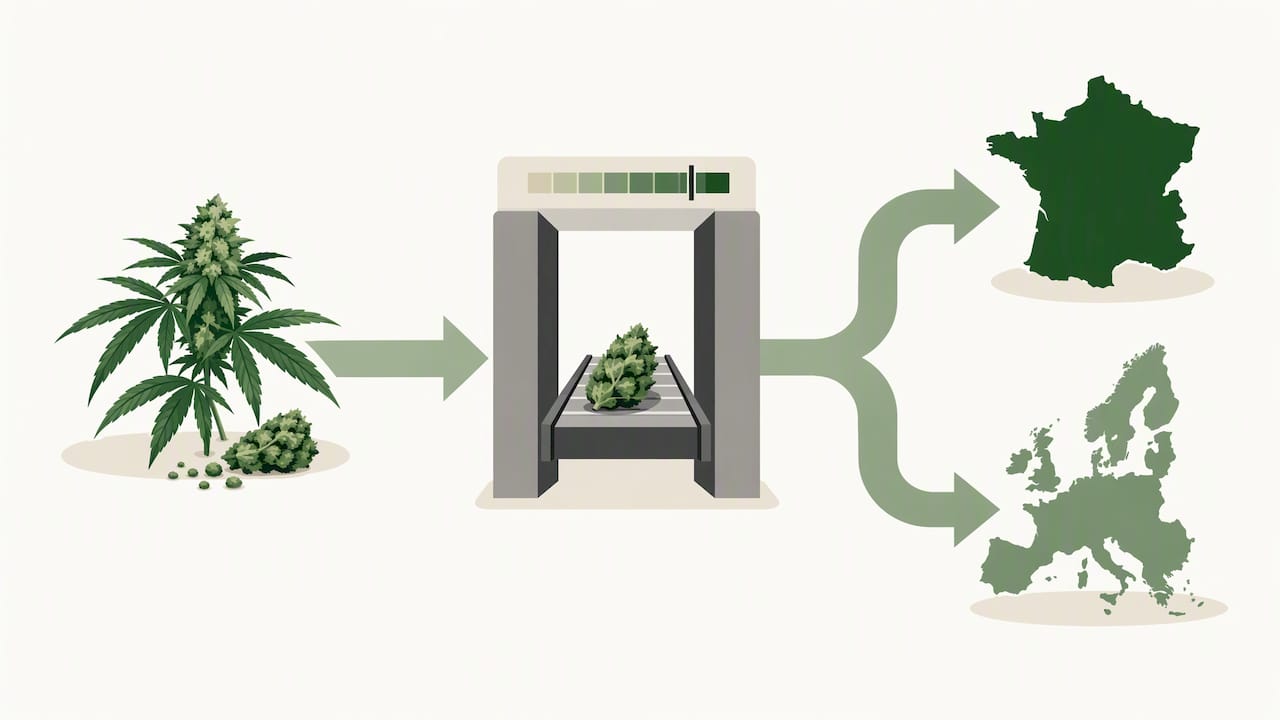
The legal framework for THCA is directly linked to the regulations governing THC, since its potential conversion makes it a controlled substance. In France, the ANSM (National Agency for Medicines and Health Products Safety) has listed several cannabinoids, including THCA, as narcotics, but this classification is contingent on the THC content of the finished product. In practical terms, a product containing THCA can remain legal if its total THC content, after decarboxylation, remains below the legal threshold set by French regulations.
This approach is based on an administrative decision dated May 22, 2024, which amends the list of substances classified as narcotics and specifies the applicable conditions. The frameworks vary considerably from one European country to another, and no common rule applies across the continent, meaning that a product compliant in one country may be prohibited elsewhere. To verify the compliance of a product containing THCA, several checks are required:
- Request a Certificate of Analysis (COA) calculating the total THC after decarboxylation, and not just the THC present when cold.
- Verify that the laboratory that performed the analysis is accredited and independent of the manufacturer.
- Control the traceability of the product, from cultivation to sale, to ensure its legal compliance.
- Consult the rules of French and European CBD legislation before any purchase, as the thresholds may change.
To delve deeper into the specifics of THCA, our guide dedicated to tetrahydrocannabinolic acid details the technical points related to its consumption and status.
Safety, drug interactions and warning signs
French drug monitoring centers have reported serious cases linked to new or derivative cannabinoids, prompting the ANSM (French National Agency for Medicines and Health Products Safety) to strengthen controls. The lack of clinical data on THCA makes it impossible to rule out a risk of interaction with certain treatments, particularly drugs metabolized by the liver.
- The symptoms reported in the reports include serious adverse effects, justifying increased vigilance from health authorities.
- A risk of addiction is mentioned for several recently classified cannabinoids, including THCA once converted to THC.
- Interactions with certain anticancer or antiviral treatments remain poorly documented, due to a lack of dedicated clinical trials, a point also addressed in our article on CBD interactions with antivirals.
- People undergoing regular medical treatment, pregnant women, and minors are subject to enhanced precautions.
Pro tip: before trying a THCA-based product, seek medical advice if you are on regular medication, even for a product marketed as non-psychoactive.
Where to find THCA and how to assess the quality of a product
THCA is found in several commercial forms: unheated acidic flowers, isolated crystals, concentrated extracts, or processed products. Each form directly influences the risk of conversion to THC, with heated acidic flowers releasing their THC much faster than a cold-stabilized extract.
- Raw acidic flowers retain a high THCA level as long as they are neither dried for a long time nor heated.
- Isolates and crystals offer measurable purity, but remain susceptible to degradation over time.
- A reliable certificate of analysis should indicate the total THC calculated after decarboxylation, and not just the THC detected cold.
- The presence of contaminant tests, such as for heavy metals or pesticides, indicates a reputable supplier.
Our guide on CBD bioavailability explains principles applicable to carboxylated forms, including the stability of acidic cannabinoids depending on their formulation.
What we really remember about THCA today
THCA suffers from a gap between its marketing promises and the available scientific evidence. The most reputable publications, such as the 2026 review on acidic cannabinoids, acknowledge a real pharmacological potential but cannot definitively confirm it in humans due to a lack of clinical trials. For several years, the supplier has relied on a rigorous selection of products derived from organic hemp, with traceability and legal compliance as constant requirements. This rigor does not replace medical advice, but it at least guarantees that the consumer has verifiable information before making an informed choice.
— Fred
What Buddha Farm's offers for proper and informed use
Choosing a cannabinoid-based product without wasting time checking each certificate of analysis yourself is an advantage that some suppliers can offer by doing this verification work upstream.

- CBD flowers and CBD resins come from controlled crops, with THC levels that comply with French regulations.
- CBD oils and CBD extracts offer stable alternatives, less susceptible to variations related to decarboxylation.
- Wellness products complement a mindful consumption approach, designed for relaxation and sleep.
Certificates of analysis are available upon request for each product. To view the full selection and verify a product's compliance before purchase, visit the Buddha Farm’s online store.
Sources
This article is based on publications from the ANSM, a study from Johns Hopkins University, an analysis published on PMC and a scientific review from 2026. The reliability of the data varies depending on the source, as clinical trials on humans remain rare.
- The ANSM adds new cannabinoids to the list of narcotics
- Comparison of decarboxylation rates of acidic cannabinoids between secretory cavity contents and air-dried inflorescence extracts in Cannabis sativa
- Therapeutic potential of acidic cannabinoids: an update
- The Pharmacokinetics and Pharmacodynamics of a Hemp-Derived “Full-Spectrum” Oral Cannabinoid Product…
Frequently Asked Questions
What are the effects of THCA?
Unlike THC, THCA does not produce a psychoactive effect unless heated. Preclinical studies suggest anti-inflammatory and neuroprotective properties, but these results have not yet been confirmed by robust clinical trials in humans.
Is THCA legal in France?
THCA is regulated by the ANSM (French National Agency for Medicines and Health Products Safety), which has classified it as a narcotic while making its tolerability contingent on the THC content of the finished product. A product remains potentially compliant if its total THC level, calculated after decarboxylation, meets the legal threshold set by French regulations.
Where can I find verified quality THCA?
THCA is primarily found in the form of acidic flowers, isolated crystals, or concentrated extracts from suppliers specializing in organic hemp. It is always advisable to request a certificate of analysis stating the total THC content after decarboxylation before making any purchase.
What are the opinions on THCA?
The available feedback remains mixed, ranging from growing marketing interest to scientific reservations about the lack of robust clinical data. Researchers particularly emphasize the need for further trials before drawing firm conclusions about its actual effectiveness.
Recommendations
- CBD Legislation France Europe: Status and Regulations
- THCA: Everything you need to know about tetrahydrocannabinolic acid, its benefits, legislation, and consumption
- CBD Oil: A Legal Dietary Supplement in 2024 – Everything You Need to Know
- Legal Alternative to HHC: Discover CRD and THV-N10 from Buddha Farm's CBD Shop


