
No. Delta-10 (D10) is not considered legal in France, and selling or using it exposes you to real legal risks. Thedecree of February 22, 1990, classifies tetrahydrocannabinols and their isomers as narcotics, and the ANSM (French National Agency for Medicines and Health Products Safety) reinforced this position in 2024. Our recommendation is simple: do not buy D10 and choose products that comply with French law.
In short:
- Delta-10 is considered a narcotic in France, as it falls into the category of tetrahydrocannabinols listed since 1990.
- Selling or possessing D10 exposes you to prosecution, even when it is presented as legal or containing less than 0.3% THC.
- Health reports of serious effects linked to neo-cannabinoids prompted the strengthening of the legal classification by the ANSM in 2024.
- Verifying the authenticity of a D10 product relies on a recent certificate of analysis and precise traceability of its manufacture, without vague claims.
- It is advisable to favour compliant CBD products, with a low THC level and a certified composition, for legal use.
Table of Contents
- The French legal framework: decree, isomers and recent developments
- What do the ANSM and addiction monitoring centers say about the health risks?
- How the market is presenting the D10, and the signals to look out for
- Legal and compliant alternatives to obtain the same benefits
- Caution, compliance and regulatory trajectory
- Discover compliant alternatives at Buddha Farm's
- Frequently Asked Questions
- Sources
The French legal framework: decree, isomers and recent developments
The reference text remains the decree of February 22, 1990, which establishes the list of substances classified as narcotics. It includes tetrahydrocannabinols in their various forms, including their isomers. Delta-10, chemically similar to Delta-9 and Delta-8, falls within this scope, even when presented as a “new cannabinoid” distinct from classic THC.
This generic labeling changes how the market is perceived. A product displaying a THC level below 0.3% may still contain an added or synthesized psychoactive isomer, which could lead to its classification as a narcotic under the 1990 legislation. Therefore, the marketing argument of the regulatory threshold does not automatically protect either the seller or the buyer.
TheANSM (French National Agency for Medicines and Health Products Safety) confirmed this trend by adding new cannabinoids to the list of narcotics during 2024, through successive decisions published in May and June. These updates apply a precautionary principle: rather than waiting for exhaustive evidence on each molecule, the authorities broaden the classifications as soon as a plausible health risk is identified.
The practical consequences affect several levels:
- Selling D10 exposes the trader to prosecution for drug trafficking, just like a classic THC-based product.
- Possession, even for personal use, remains punishable like the possession of any listed substance.
- Importing from a country where the D10 circulates more freely does not change anything with regard to French law, since it is the destination that determines the applicable rule.
Customs and police services rely on the consolidated annex of the text and on the decisions of the ANSM to classify these products, which means that platforms selling D10 online are already, in concrete terms, exposed to seizures and prosecutions.
What do the ANSM and addiction monitoring centers say about the health risks?
The classification of D10 is not based solely on legal logic: it relies on concrete health indicators. Addiction monitoring centers have documented serious cases linked to neo-cannabinoids, including vomiting, seizures, loss of consciousness, and episodes of tachycardia or paranoia.
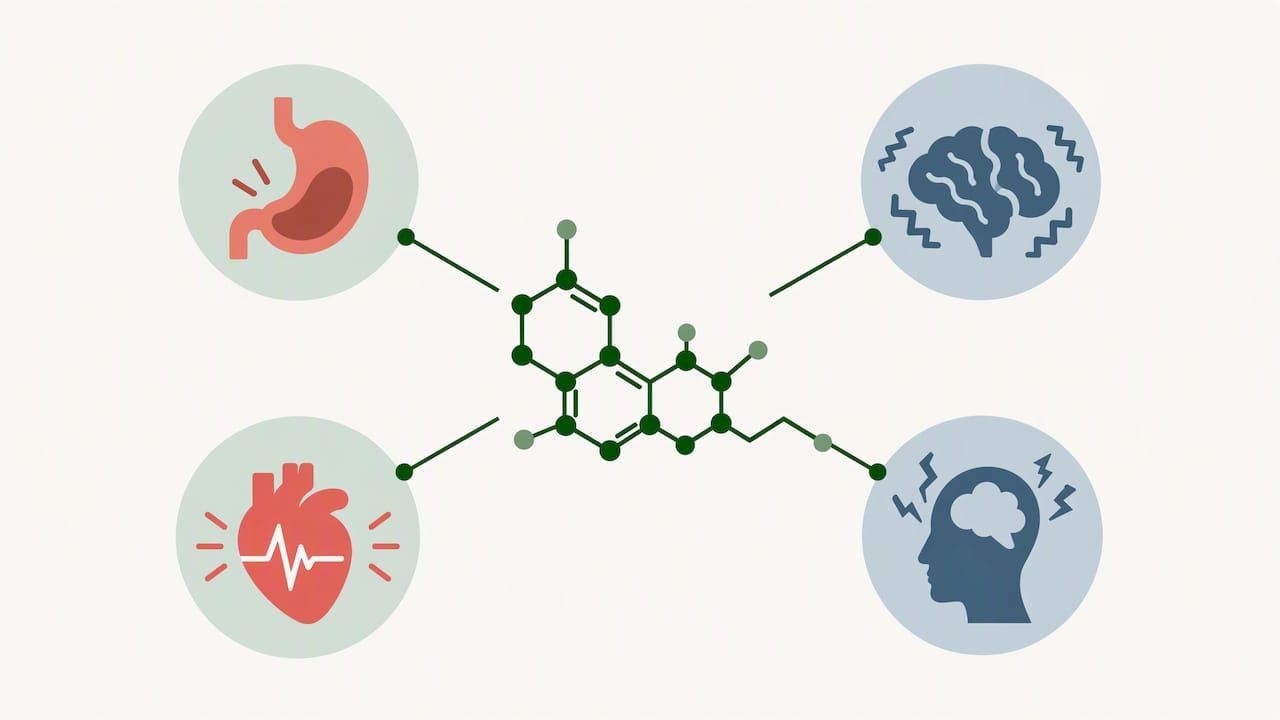
The reports collected by the addiction monitoring centers (CEIP-A) directly informed the ANSM's classification decisions in 2024, illustrating the role of this monitoring in the construction of applicable law.
Several factors explain this increased vigilance:
- D10 is most often obtained by chemical transformation of CBD, a process that can leave uncontrolled residues of solvents or catalysts.
- The exact composition of a product sold as “D10” varies greatly from one supplier to another, making it impossible to reliably assess the risk for the buyer.
- The lack of standardized quality control for these synthetic molecules increases the likelihood of unforeseen adverse effects.
This uncertainty about the actual composition is, in itself, sufficient reason to avoid this type of product, even apart from the legal question; for a comparative European framework on these issues, see our article on CBD legal in Germany.
How the market is presenting the D10, and the signals to look out for
These arguments ignore the clause on isomers included in the 1990 decree and suggest a grey area which does not legally exist in France.
To evaluate a product description before making a purchase, here are the points to check in order:
- Check for the presence of a Certificate of Analysis (COA) issued by a third-party laboratory, dated and signed.
- Look for clear information about the origin of the raw material and the processing method used.
- Beware of vague claims such as “new legal cannabinoid” without reference to an official text.
- Compare the traceability information with that displayed on a page dedicated to CBD legislation in France and Europe.
- Avoid any shop that does not specify the method of obtaining the molecule (natural extraction or chemical synthesis).
Pro tip: a COA that is not dated or signed by the laboratory is, in practice, equivalent to the absence of a COA: never rely on a simple screenshot without verifying its authenticity with the issuing laboratory.
To better distinguish the acronyms circulating on the market, our page dedicated to neo-cannabinoids such as CBX, CBS or D10 details the differences between these molecules.
Legal and compliant alternatives to obtain the same benefits
Faced with this uncertainty, we systematically direct customers towards products whose conformity can be verified point by point. A reliable product always has the following characteristics:
- A recent third-party COA, mentioning the measured but undeclared THC level.
- Complete traceability from seed to harvest, including the cultivation method.
- A stable composition, without the addition of undeclared synthetic molecules.
- A THC level of less than 0.3%, measured and not simply announced.
Several categories allow you to achieve the desired effects (relaxation, sleep aid, general calming) without exceeding the legal framework:
| Category | Main use | Points to be aware of when buying |
|---|---|---|
| CBD flowers | Relaxation and unwinding at the end of the day | Check the COA and the cultivation method (organic, indoor, outdoor) |
| CBD Resin | Long-lasting effect, controlled dose consumption | Control the origin of the extraction |
| CBD oil | Precise dosage, discreet and smokeless use | Check the announced concentration against the COA |
Our pages on CBD flowers, CBD resin , and CBD oil detail these criteria for each product. Before making any purchase, always compare the traceability information on a product page with the requirements described on our page dedicated to applicable legislation.
Caution, compliance and regulatory trajectory
Our position remains unchanged: legal compliance and transparency take precedence over any marketing promises surrounding a “new cannabinoid.” The trend observed since 2024, with faster classification of risky molecules, will continue as new adverse drug monitoring reports emerge. In the medium term, the safest option remains to favor traceable producers committed to organic farming and able to document each stage of production.
— Fred
Discover compliant alternatives at Buddha Farm's
We offer a range of products whose legal compliance is verifiable, from cultivation to final laboratory analysis.

Rather than seeking an uncertain substitute for D10, we recommend starting with the following categories:
- CBD flowers for immediate relaxation, with COA available on each product page.
- CBD resins for a longer lasting effect, sourced from controlled crops.
- CBD oils for precise dosage and discreet daily use.
Each product sheet provides information on the certificate of analysis and traceability, allowing verification of conformity before purchase.
This article provides general information and is not a substitute for professional medical advice. Consult a qualified healthcare professional about your specific situation before taking any action based on this content.
Frequently Asked Questions
Is D10 strictly prohibited in France?
Delta-10 is not authorized for sale or consumption in France, as the decree of February 22, 1990 classifies tetrahydrocannabinols and their isomers as narcotics. This generic classification covers D10 even when it is presented as a molecule distinct from classic THC.
Why do some sites display “D10 legal” despite the ban?
Some sellers rely on the 0.3% THC threshold to give the impression of general legality, ignoring the clause on isomers provided for in the 1990 text. The ANSM has also strengthened the classifications of cannabinoids in 2024 precisely to correct this type of misleading commercial discourse.
What health risks are associated with D10?
Addiction monitoring centers have recorded cases of vomiting, convulsions, loss of consciousness and tachycardia linked to neo-cannabinoids, according to the 2023-2024 addiction monitoring report. These reports directly motivated the strengthening of classifications by the ANSM.
What is the legal difference between D8 and D10?
Delta-8 and Delta-10 are two isomers of THC and therefore follow the same legal framework in France, since the 1990 decree covers tetrahydrocannabinols in their various forms. Neither enjoys a legal status distinct from that of classic THC.
Sources
- Decree of 22 February 1990 establishing the list of substances classified as narcotics
- The ANSM adds new cannabinoids to the list of narcotics


