
In 2026, CBD remains authorized under certain conditions: a THC content of 0.3% in the finished product, compliance with the declared use, and adherence to the European Novel Food Regulation. Since May 15, 2026, foodstuffs containing CBD are prohibited without Novel Food authorization. Flowers, resins, non-food oils, and cosmetics remain marketable under these same conditions.
In short:
- The sale of food products containing CBD has been prohibited since May 15, 2026 in the absence of Novel Food authorization, but flowers, resins, non-food oils and cosmetics remain marketable under certain conditions.
- Only non-food products, such as cosmetics or vapes, can continue to be sold, while the ingestion of CBD is strictly regulated by strengthened regulations.
- Caution is still advised: it is necessary to verify that the THC level does not exceed 0.3%, that the product is intended for the declared use, and to request a precise certificate of analysis for each batch.
- The provisional safety limit set by EFSA is very low, around 0.0275 mg per kilo of body weight per day, but does not constitute a general sales authorization.
- The legal framework, which is often modified, could evolve further depending on scientific opinions and administrative decisions, making compliance fragile.
Table of Contents
- Summary legal framework: texts, thresholds and authorities
- What can you still buy in 2026: flowers, oils, cosmetics
- Novel Food and EFSA opinion: why CBD foods are targeted
- Practical checks and pre-purchase checklist in 2026
- Key regulatory timeline from 2018 to 2026
- Consequences and prospects for consumers and the industry
- Compliance and best practices: a salesperson's perspective on the sector
- Where to find compliant products at Buddha Farm's
- Sources
- Frequently Asked Questions
Summary legal framework: texts, thresholds and authorities
The framework rests on three pillars. This threshold applies to the product sold, not to the raw plant before processing, and it conditions the entire marketing chain.
The second pillar concerns food. Regulation (EU) 2015/2283 requires that any ingredient not consumed in significant quantities before 1997 obtain authorization before being placed on the food market. CBD is considered such an ingredient when it is incorporated into a beverage, edible oil, or capsule intended for ingestion.
The third pillar is institutional.
- The Ministry of Agriculture, via the DGAL, monitors compliance with Novel Food status and orders the withdrawal of non-compliant products.
- EFSA assesses the safety of ingested CBD and publishes scientific opinions that guide regulatory decisions.
- The Council of State settles disputes between professionals and the administration regarding the legality of decrees.
- Légifrance centralizes the texts in force, useful for verifying a primary source before purchase.
This distribution explains why the same product can be legal in one form and prohibited in another: the law does not only judge the molecule, it judges the use to which it is put.
What can you still buy in 2026: flowers, oils, cosmetics
Since the Council of State's decision in December 2022, the sale of hemp flowers and leaves with low THC levels has been permitted. The judge ruled that the blanket ban was disproportionate due to a lack of sufficient scientific evidence of a health risk distinct from that already covered by the THC threshold. This decision remains the legal basis that currently allows the sale of raw flowers in stores.
Usage changes everything. The same CBD extract can be sold as a cosmetic, as an e-cigarette liquid, or as a food supplement, and each of these uses is subject to different regulations.
- Cosmetics follow European regulations on cosmetic products and are not affected by Novel Food status.
- Vaping liquids fall under a specific framework related to electronic devices, distinct from that of foodstuffs.
- Products intended to be swallowed (gummies, drinks, supplements, cooking oils) fall under the Novel Food ban since May 15, 2026.
- Smoked or cold-infused flowers and resins remain tolerated as long as the THC remains below the legal threshold and the product is not presented as a food product.
This distinction between inhalation, cutaneous application and ingestion structures the entire sector and explains why some sections have disappeared from shops while others remain unchanged.
Novel Food and EFSA opinion: why CBD foods are targeted
The rationale behind the ban on food products stems not from political pressure but from a lack of scientific evidence. The Novel Food Regulation requires manufacturers to prove the safety of their ingredients before placing them on the food market, and no CBD product has yet received this full authorization in France.
**In February 2026, EFSA set a provisional safe intake level of a few milligrams per kilogram of body weight per day, with an estimate close to 0.0275 mg per kilogram of body weight per day, which corresponds to a low daily dose. This figure remains provisional: the agency itself notes data gaps, particularly regarding potential effects on the liver and the endocrine and reproductive systems, and it excludes those under 25 years of age, as well as pregnant or breastfeeding women, from the scope of this estimate.
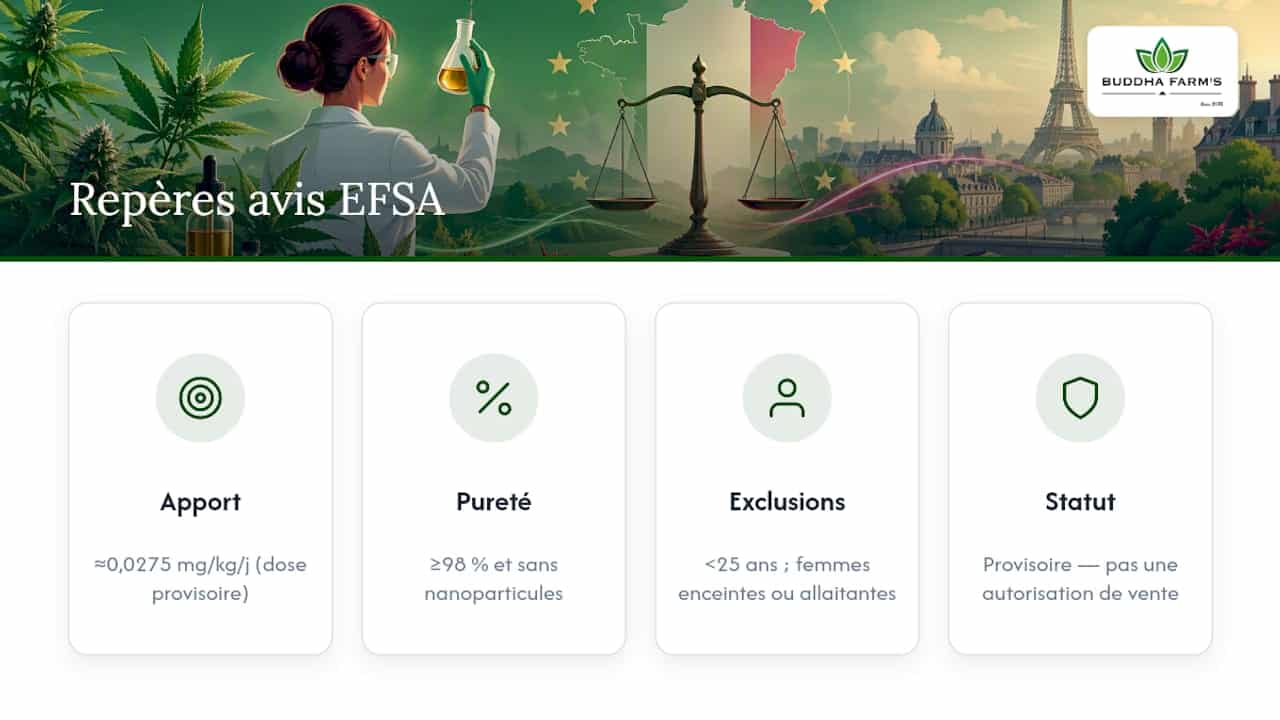
This provisional level applies only to specific formulations with a CBD purity of 98% or higher and without nanoparticles. It does not, under any circumstances, constitute authorization for general sale. It is precisely this scientific caution that served as the basis for the DGAL's announcements in the spring of 2026 and the stricter enforcement of the withdrawals since May 15th.
Practical checks and pre-purchase checklist in 2026
Before making a purchase, a few simple checks can help you avoid buying a defective product. The process takes only a few minutes and relies on information that any reputable seller should provide without hesitation.
- Check the THC level indicated on the label: it must be less than or equal to 0.3% for the finished product.
- Identify the declared use category (cosmetic, vaping, food supplement) and make sure it corresponds to the actual use you will make of it.
- Identify the manufacturer or importer, which should be clearly visible on the container or product information sheet.
- Request the certificate of analysis attached to the specific batch purchased, never a generic document valid for an entire range.
- Check that the values on the certificate correspond to the batch in question: date, batch number and THC level must match the product received.
Pro tip: A certificate of analysis that does not mention the exact batch number of the product purchased has no probative value, even if it bears the name of the correct manufacturer.
If doubt persists, two options are available. Reporting a suspicious product to the DGAL (Directorate General for Food), while the website rappel.conso.gouv.fr lists recalls already issued by the authorities. Both channels cover in-store and online sales, as inspections make no distinction between the two.
Key regulatory timeline from 2018 to 2026
Understanding the current situation requires revisiting a few key dates. Each one has altered the balance between prohibition and tolerance.
- 2020: The Kanavape ruling of the Court of Justice of the European Union establishes the principle of proportionality, obliging states to scientifically justify any ban on CBD.
- December 30, 2021: a French decree attempts to ban the marketing of hemp flowers and leaves, provoking immediate litigation.
- December 29, 2022: The Council of State overturns this ban, deeming the measure disproportionate.
- February 2026: EFSA publishes its provisional safe intake level for CBD, the first quantified scientific assessment on this scale.
- April and May 2026: the DGAL announces the withdrawal of food products containing CBD and generalizes controls from May 15.
This succession shows a pendulum swing: justice first relaxed the framework, then science justified a tightening targeted on a single segment, that of food.
Consequences and prospects for consumers and the industry
The removal of CBD-infused food products has tangible effects. Some products disappear from shelves overnight, fueling a parallel market that is less traceable and therefore riskier for the buyer.
- Recalls and withdrawals are increasing for unauthorized gummies, drinks and food supplements.
- Industry professionals are facing increased controls and growing legal pressure before administrative courts.
- Cautious consumers can turn to compliant cosmetics, inhaled products respecting the THC threshold, or hemp seeds and fibers, whose status has never been questioned.
For the sector, stability remains fragile. The legal framework has already changed several times in five years and there is no indication that it will become fixed after 2026, especially if the EFSA refines its scientific assessment in the years that follow.
Compliance and best practices: a salesperson's perspective on the sector
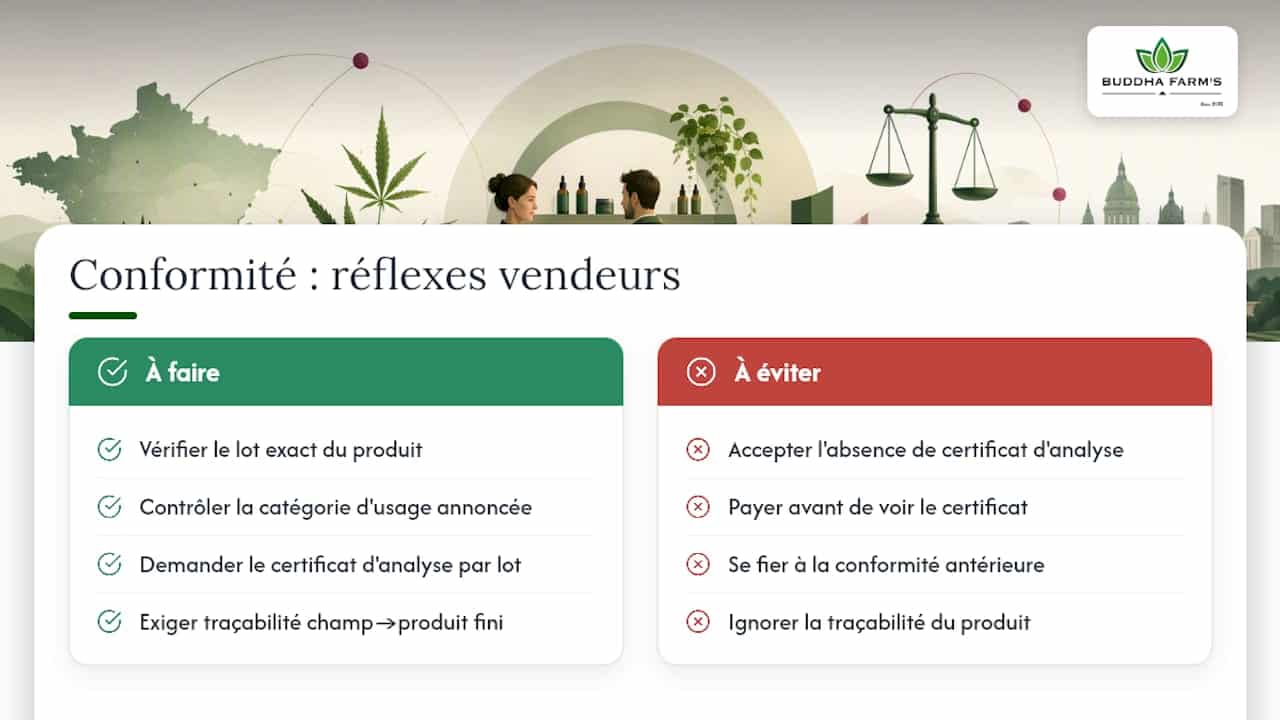
A responsible seller does more than simply comply with the legal THC limit. Complete traceability, from field to finished product, with a batch analysis certificate, remains the only reliable guarantee for a buyer.
Three key points are worth repeating: verify the exact batch, check the stated intended use category, and request the certificate of analysis before making any payment, not after. The legal framework has changed several times since 2020, and there's no guarantee it will remain unchanged after 2026. Therefore, caution is still advised, even for a product that appeared compliant the previous week.
— Fred
Where to find compliant products at Buddha Farm's

The products offered are selected for their traceability and compliance with French legal requirements, with a focus on organic hemp. Categories compliant with current regulations remain available online and in stores.
- CBD flowers and CBD resins, sold below the legal THC threshold.
- CBD oils not intended for ingestion and wellness products for topical use.
- CBD extracts and vaping and vaporizer.
Each product description specifies the intended use category and available analysis for the batch in question. If you have any questions about a particular item, Buddha Farm should be your first point of contact before making a purchase.
Sources
To delve deeper, CBD legislation in France and Europe details the complete legal framework, whileEvidena's analysis of the European framework places France among its neighbors.
- Food products containing cannabidiol (CBD): illegal products that must be removed from the market | Ministry of Agriculture, Food and Food Sovereignty
- Provisional safe level for cannabidiol as a novel food | EFSA
- CBD: Annulment of the decree banning the sale of cannabis flowers and leaves without narcotic properties – Council of State
- Regulation (EU) 2015/2283 on Novel Foods
Frequently Asked Questions
Will CBD be banned in France from May 15th?
No, only food products containing CBD are affected by the ban applied since May 15, 2026. Flowers, resins, non-food oils and cosmetics remain marketable subject to compliance with the THC threshold.
What is the future of CBD in France after 2026?
The framework is expected to continue evolving based on scientific opinions from EFSA and decisions from administrative courts. There is no indication of a general tightening of regulations, but the food sector remains the most uncertain until a Novel Food authorization is granted.
What is the new rule on CBD in 2026?
The main change is the withdrawal of food products containing CBD, announced by the DGAL (Directorate General for Food) and implemented since May 15, 2026, in the absence of Novel Food authorization. Other product categories, such as flowers or cosmetics, are not affected by this measure.
Is it legal to smoke CBD in France?
Smoking CBD flowers remains tolerated as long as the THC level does not exceed 0.3%, in accordance with the decision of the Council of State of December 2022. This tolerance concerns use by inhalation and does not extend to products intended to be ingested.


