


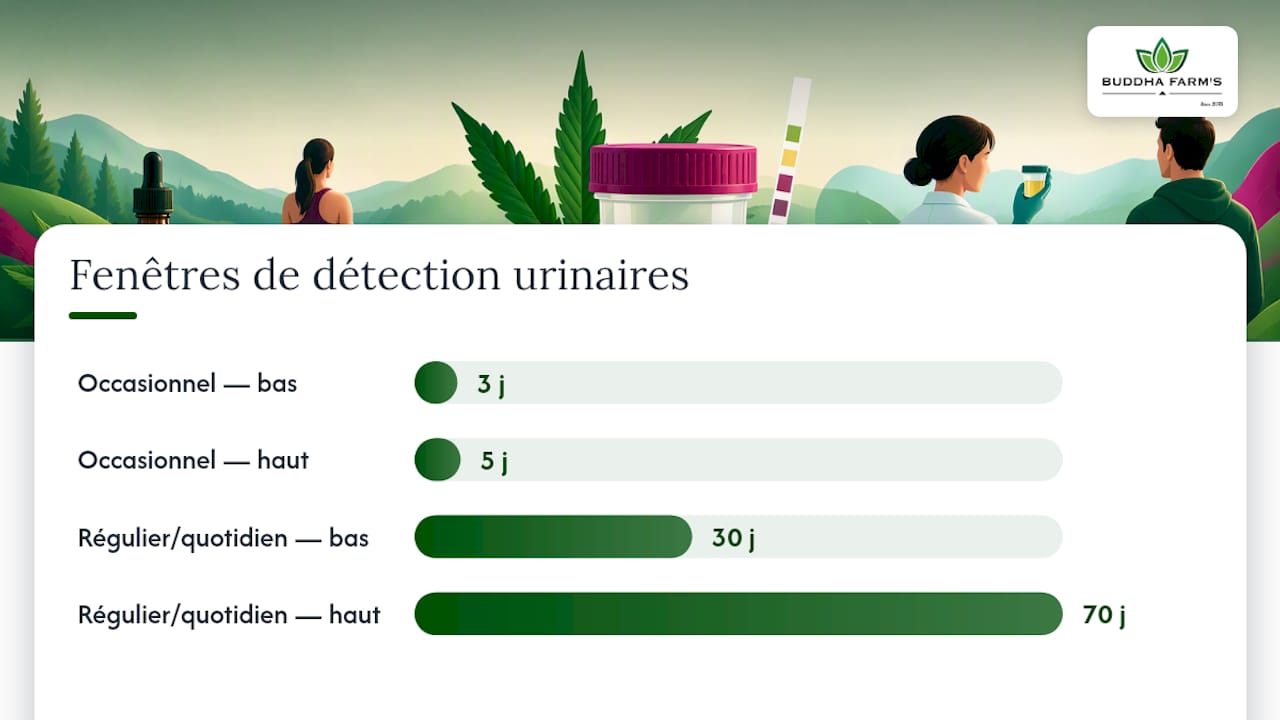
Urine tests do not detect CBD. They target THC-COOH, a metabolite of THC. Occasional THC use remains detectable for approximately 3 to 5 days, while regular use can detect it for up to 30 to 70 days. Even a compliant full-spectrum product may contain sufficient trace amounts to trigger a positive result.
In short:
- THC-COOH detection in urine can last from 3 to 5 days for occasional use, up to 70 days for regular use.
- The duration of positivity depends mainly on the frequency of use and the quantity consumed, the type of product, and the morphology of the user.
- A full-spectrum product may contain traces of THC sufficient to trigger a positive test, even if it complies with regulations.
- Initial tests use a legal threshold of 50 ng/mL in France, but confirmation by LC-MS/MS is more reliable and can use a lower threshold.
- No CBD product guarantees the total absence of THC; the only reliable solution remains prior cessation depending on the duration of consumption.
Table of Contents
- Detection time for THC and CBD in urine: figures and limits
- Factors that lengthen or shorten the detection window
- How urine tests work and the legal framework in France
- Why some CBD products give positive results
- Practical tips to reduce the risk of a positive test
- Buddha Farm's perspective: caution and traceability
- Sources
- Frequently Asked Questions
Detection time for THC and CBD in urine: figures and limits
The body eliminates CBD fairly quickly, leaving no trace detectable by standard tests. The key question, therefore, is that of THC, or more precisely its metabolite, THC-COOH, the only compound tested for by laboratories in urine.
Detection ranges vary greatly depending on the frequency of use:
These figures are not fixed rules. Studies on the urinary pharmacokinetic profile of cannabinoids show that urinary concentrations reach a peak a few hours after ingestion, then decrease according to a curve that depends on the dose, the route of administration and individual metabolism.
The key takeaway: the detection window depends on the THC-COOH metabolite, not on active THC or CBD, which explains why two people who have consumed the same amount can obtain different results.
Factors that lengthen or shorten the detection window
The duration of a positive test is never the same from one person to another. Several factors play a role, some related to the product, others to the body.
- The frequency and quantity consumed remain the main factor: the more regular the use, the more THC-COOH accumulates in fats.
- The type of product also matters: a full-spectrum contains traces of THC, unlike an isolate which is theoretically devoid of it.
- The route of administration modifies the rate of absorption: inhalation acts faster than oil or capsule, but persistence depends mainly on lipid storage.
- Morphology and hydration influence urinary concentration: a high body mass index promotes the storage of THC-COOH, while very dilute urine can temporarily lower measured levels.
- The sensitivity of the test varies depending on the laboratory: a classic immunoassay and a confirmation by LC-MS/MS do not detect the same thresholds.
Pro tip: never rely on a single factor to assess your risk: the combination of frequency, product and metabolism weighs more than each element taken in isolation.
How urine tests work and the legal framework in France
A urine test is carried out in two stages. A rapid immunoassay serves as an initial screening. In the event of a positive result, confirmation by chromatography, GC-MS or LC-MS/MS, validates or refutes this first result with much greater precision.
In France, thedecree of December 13, 2016 sets the urinary screening threshold for THC-COOH at 50 ng/mL. Some confirmatory tests use a lower threshold, around 15 ng/mL, which explains why a negative screening result can sometimes be reclassified after laboratory confirmation.
This point deserves clarification:
- The analytical threshold determines what a test can technically detect.
- The legal threshold determines what constitutes a traffic offence.
From a legal standpoint, the presence of THC in the body is sufficient to constitute the offense of driving under the influence of narcotics, regardless of the source of the THC or the dose ingested, as established by case law concerning driving after consuming CBD. Therefore, consuming CBD offers no protection against a roadside check if the product contained even the slightest trace of THC. For further information on this topic, the page on CBD legislation in France and Europe details the applicable regulations.
Why some CBD products give positive results
A CBD product label does not always guarantee its actual composition. French authorities themselves acknowledge thatCBD product labeling can be unreliable, with traces of THC present without being declared on the packaging.
A study published in JAMA Psychiatry followed users for four weeks of using a full-spectrum CBD-rich product. The result: 7 out of 14 participants, or half the group, tested positive for THC-COOH in their urine.
Several mechanisms explain this phenomenon:
- Full-spectrum products, by definition, retain traces of Δ9-THC, even in legal quantities.
- Some derivatives such as delta-8 or delta-10 generate similar metabolites, sometimes detected by the same tests.
- Concentrated urine, characterized by a high creatinine level, reaches analytical thresholds more quickly.
To limit this risk, it is best to request a recent certificate of analysis from an independent laboratory and consider using an isolate when occupational exposure to a controlled substance is high. The technical file on delta-9 THC details the differences between these molecules.
Practical tips to reduce the risk of a positive test
Faced with a scheduled or probable inspection, a few concrete precautions limit exposure without giving in to panic.
- Anticipate a stopping period proportional to your use: a few days for occasional use, several weeks for regular use, taking into account the range of 3 to 70 days mentioned above.
- Choose certified isolates, accompanied by a recent certificate of analysis, rather than full-spectrum products whose exact composition remains uncertain.
- Hydrate normally, but not excessively: excessive water consumption before a test is detected by laboratories via creatinine levels and can be interpreted as an attempt at fraud.
- In case of a positive result, always request confirmation by LC-MS/MS before any conclusion, as this analytical threshold is more reliable than the initial screening.
Pro tip: no method completely eliminates the risk as long as a product contains even the slightest trace of THC; stopping sufficiently remains the only truly reliable strategy.
Buddha Farm's perspective: caution and traceability
No CBD product, however rigorously selected, completely eliminates the risk of a positive test if a trace of THC remains in its composition. Our commitment focuses on the traceability and legal compliance of each product, but the responsibility remains shared between the seller and the consumer. Before undergoing a sensitive test, it's best to consult the product information sheets and the section dedicated to CBD legislation rather than relying solely on marketing claims.
— Fred
Sources
- Order of 13 December 2016 (procedures for drug screening)
- Urinary pharmacokinetic profile of cannabinoids following administration
- Urinary tetrahydrocannabinol after 4 weeks of a full‑spectrum, high‑cannabidiol treatment
- Drugs Info Service — Information on CBD
Frequently Asked Questions
Does CBD test positive in a urine test?
Pure CBD does not trigger a positive result because urine tests look for THC-COOH, not CBD. The risk comes from trace amounts of THC sometimes present in full-spectrum products, as shown in a JAMA Psychiatry study where half of the participants tested positive after four weeks of use.
How long does CBD remain detectable in urine?
CBD itself is not the molecule targeted by standard urine tests. It is THC-COOH that remains detectable, 3 to 5 days after occasional THC use and up to 30 to 70 days after regular use.
What can cause a urine test to be inaccurate?
Urine that is too diluted due to excessive hydration can artificially lower measured concentrations, which laboratories detect via creatinine levels. A mislabeled CBD product containing undeclared traces of THC can also cause an unexpected result, as reported by Drogues Info Service.
Will I test positive if I smoke CBD?
Smoking a compliant CBD flower with minimal THC content presents a lower risk than prolonged use of full-spectrum cannabis, but it is never zero. The presence of THC, even in trace amounts, is legally sufficient to constitute a traffic violation according to current case law, regardless of the dose or source.


