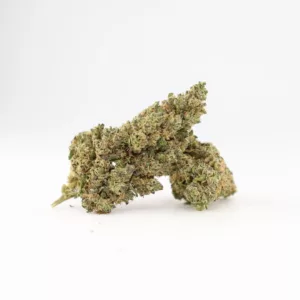
Looking closely at a CBD flower, you've probably noticed small, shiny dots on its surface. Under certain lighting, they give the bud a slightly frosted appearance. Commercial descriptions then refer to the flowers as "resinous," "crystallized," or "rich in trichomes.".
These structures are of legitimate interest. The glandular trichomes of cannabis participate in the production and accumulation of cannabinoids and terpenes. Their role is documented by research on the plant's anatomy and metabolism. pubmed.ncbi.nlm.nih.gov
But a brilliant photograph is not the result of analysis. To choose a flower, one must distinguish between what the eye can observe, what a description suggests, and what a document allows one to verify.
What exactly are trichomes? How can you tell them apart from the small orange filaments often called pistils? Does a very frosty flower necessarily contain more CBD? Here are some key points to help you better understand Buddha Farm’s CBD flowers and compare different products more accurately.
What is a trichome on a hemp flower?
The word trichome refers to a structure on the surface of a plant. In cannabis, not all of these structures have the same shape or function.
Glandular and non-glandular trichomes
The literature distinguishes between secretory trichomes, known as glandular trichomes, and non-secretory trichomes. The former include several forms, generally described as bulbous, sessile, and pedunculated.
Stalked forms have a head supported by a more developed stalk. Other structures have a very short stalk or are smaller in size. This diversity explains why the word "trichomes" should not be interpreted as a perfectly uniform category. pmc.ncbi.nlm.nih.gov
When reading a product description, the key point remains simple: when the seller mentions resinous trichomes, they are usually referring to glandular structures. They are not describing all the small bumps visible on the flower.
Structures studied with specialized tools
Researchers use microscopy and chemical analysis methods to characterize these structures. A study by Livingston and colleagues showed that sessile and stalked trichomes differ in several anatomical and metabolic characteristics.
Their general appearance therefore does not encompass their full diversity. doi.org
You don't need to replicate this scientific work to choose a reference. However, understanding it helps you put commercial photographs into perspective.
"Crystals" is primarily a descriptive term
In catalogs, the word "crystals" is often used to describe a visual impression. To understand what is actually being advertised, look for the full description.
Is it simply a flower presented as resinous? A close-up photograph? A product whose composition includes declared additives?
These situations require different interpretations. Do not deduce the exact nature of a product from a single adjective.
Trichomes and pistils: how to distinguish them?
The small shiny elements and the orange filaments do not refer to the same thing.
The visible filaments are often called pistils
In commercial terminology, the term pistils is frequently used to refer to the filaments protruding from flowers. More precisely, the filamentous parts observed correspond to the stigmas.
Illustrations from a 2023 study clearly distinguish these stigmas, which turned orange to brown in the photographed samples, from the trichomes present on the surrounding tissues. pubmed.ncbi.nlm.nih.gov
When you observe a head, you can therefore separate the long visible filaments from the small surface structures.
A confusion that changes how the photos are interpreted
A photograph showing numerous orange filaments may appear very detailed. This does not mean that it accurately documents the glandular trichomes.
Look at what is actually being developed. Do you see the filaments, the small leaves, the overall structure, or the surface details?
This question allows you to better understand what the visual aspect brings to your comparison.
Table of key reference points
| Element observed | Useful description | Limit for your purchase |
|---|---|---|
| Orange or brown filaments | Often called pistils; the visible parts corresponding to the stigmas | They do not provide a CBD content |
| Small, shiny dots | These may correspond to visible glandular structures | Their identification depends on sharpness and magnification |
| Frosty appearance | General surface impression | This does not constitute an analytical measure |
| Small leaves around the head | Elements of the plant presentation | They should not be confused with the whole flower |
| Green or purple | Visual characteristic of fabrics | Does not replace composition information |
This table helps you describe what you see. It does not transform an observation into a complete diagnosis of the product.
Does a flower rich in trichomes necessarily contain more CBD?
The link between glandular structures and plant compounds explains the researchers' interest. It does not, however, justify an impromptu calculation based on a photograph.
Density requires a measurement method
A scientific review published in 2025 highlights the difficulties in quantifying trichomes. The tissue chosen, the surface examined, the size, shape, and maturity of the structures must be taken into account to interpret a density.
The authors highlight, in particular, the lack of perfectly harmonized methodologies in the literature. pubmed.ncbi.nlm.nih.gov
Counting a few bright spots on an enlarged area is therefore not the same as measuring the entirety of a product.
Visible quantity and composition are two questions
To find out the stated content of a product, consult the corresponding analytical information. To appreciate its presentation, look at the images and the description.
This separation is useful even if you prefer particularly resinous flowers. You can appreciate this aspect while still requiring clarity regarding the product's information.
Avoid comparing different photos
A head photographed under raking light and another under diffuse lighting cannot be directly compared solely on the number of reflections.
Before making a ranking, ask yourself if the viewing conditions are comparable. With most online purchases, you don't have this guarantee.
Then use the photographs to appreciate the presentation and the documents to examine the announced data.
What does research on trichomes and cannabinoids show?
Studies help us understand their role without attributing to a commercial photo a level of precision it does not possess.
Analyses locate compounds within surface structures
A 2023 publication used mass spectrometry imaging techniques on cannabis leaves and their trichomes. The results provide visual insights into the production and accumulation of cannabinoids in these structures.
The methods used go far beyond simple observation with a magnifying glass. They combine the image with chemical identification within the framework of the studied protocol. pubmed.ncbi.nlm.nih.gov
The results must remain in their context
A search can examine individual leaves, a specific population, or THC-rich varieties. It does not automatically describe all batches of CBD flowers sold in France.
When you read an article, look at what has been studied: tissue, variety, stage of development and method.
This habit will help you distinguish a general botanical explanation from a statement about a specific commercial reference.
A study does not certify a catalog
A seller might cite research to explain trichomes. To document their own product, they then need information that is relevant to it.
Keep these two levels separate: science explains a phenomenon; the information sheet and documents in the set inform your purchase.
Transparent, milky or amber trichomes: how to read these terms?
These words often appear in content about cannabis curing. For the buyer of prepared flower, their meaning must be understood.
Maturation is a research topic
The work of Punja and his collaborators studied the development and morphology of trichomes in two THC-rich cannabis genotypes. They demonstrate the influence of genotype and developmental stage on the observed characteristics.
These observations pertain to the plants and conditions examined. They do not constitute a universal framework for predicting the properties of any packaged CBD flower. doi.org
A picture of a finished product doesn't tell the whole story
If a product description states that the trichomes are "amber," ask what this description contributes to your decision. Is it based on a visual of the batch? An observation by the producer? A general presentation?
You can appreciate the information, provided you do not use it to replace composition or traceability data.
Don't turn a color into a personal promise
A visual category should not become a guarantee of individual results. If your purchase is based on a specific promise, look for the elements that support it.
To compare products, go back to the clearly defined information: format, stated composition, aromatic profile and quantity.
How to observe a CBD flower without overinterpreting it?
You can examine a flower with curiosity while remaining precise about what your observation reveals.
Start with the set
Before focusing on a detail, look at the overall presentation: size of the buds, homogeneity of the bag and advertised finish.
A macro photograph can make a tiny area look impressive. The overall view helps you maintain proportions.
Next, compare this presentation to the format indicated in the sheet.
Use neutral lighting
To describe a flower, use simple and stable lighting. Avoid significantly altering the contrast or saturation of the photo you wish to send to the seller.
Your goal is to showcase the product, not to enhance its reflections.
This precaution also facilitates communication with customer service if you have a question about the appearance received.
Describe before concluding
You can write "small light dots visible", "numerous orange filaments" or "surface brighter from this angle".
These observations remain more rigorous than an immediate conclusion about a production rate or method.
If you require an explanation, please attach the reference and batch information to your request.
Can a magnifying glass be used to judge the quality of a flower?
A magnifying glass provides magnification. Its function should not be confused with that of a laboratory.
It can help you discover the structure
Close observation makes botanical discovery interesting. You will be able to better distinguish different visible elements and understand the vocabulary used in the descriptions.
However, take the time to determine what you are looking at. Magnification without reference points does not automatically guarantee correct identification.
It does not measure the composition
If your question relates to CBD, THC, or another advertised compound, look for the relevant analytical result.
A visual observation and a chemical measurement answer different questions. You can use both pieces of information, each in its own role.
It does not replace batch checks
To find out the scope of the checks carried out, consult the available documents and the parameters examined.
Don't assume that a normal appearance covers all quality issues. Conversely, if something surprises you, ask for clarification before attributing a cause to it.
What is the relationship between trichomes and CBD resin?
The two terms are linked in the vocabulary of hemp, but do not denote exactly the same level of description.
The flower contains glandular structures
Trichomes are among the botanical elements studied in plants. A flower can be described based on their visible appearance.
The word resin can, depending on the context, refer to resinous material or a category of processed product.
The resin being sold must have its own description
If you are exploring Buddha Farm’s CBD resins, look at the composition, the advertised method and the format of each reference.
The general explanation of trichomes is not sufficient to document a specific piece of resin.
This will allow you to compare the category without assuming that all preparations have the same characteristics.
Don't confuse vocabulary with proof of manufacture
Expressions like "trichome selection" or "resinous material" become more useful when accompanied by explanations.
If this information plays a decisive role in your choice, ask what it means for the product in question.
Indoor flowers, greenhouse flowers and small buds: what criteria should you look at?
The catalogue categories provide you with additional reference points.
The cultivation method constitutes a separate piece of information
Indoor and greenhouse describe the advertised growing environment. To compare products, then examine the specific characteristics of each model.
You can browse indoor and Cali CBD flowers or greenhouse flowers according to your preferences.
The frosted appearance of a photo should not be used to guess cultural information that should be specified in the text.
The caliber describes the presentation sold
A small flower head photographed up close can appear large. Therefore, check whether the offer includes large flowers, mixed sizes, or small heads.
The baby buds and small buds CBD category allows you to identify this latter format.
Next, compare the price for the quantity actually selected.
Choose your priorities
If presentation is important to you, consider the caliber and finish. If your priority is the aromatic profile, start with the advertised notes.
If you are looking for an affordable option, compare the total order and product references in the low-priced CBD.
Visual details then become one criterion among those that interest you.
How do you read a description that says "very resinous"?
A business formula can be useful if you know what it describes.
Look for the details that accompany it
Does the product sheet offer representative images? Does it describe the format and aromatic profile? Does it clearly present the advertised data?
These elements give substance to the formula.
Without further specification, "very resinous" remains primarily an assessment of presentation.
Avoid adding superlatives
“Frosted”, “premium” and “exceptional” do not constitute three independent measures of quality.
To compare two references, focus on the specific information rather than the number of adjectives.
You will be better able to identify what justifies your preference and any potential price difference.
Request a response related to your need
A question like "what elements distinguish this reference from the other?" invites the seller to clarify their offer.
You can indicate your priorities: presentation, format, aromatic notes or documentation.
The answer will be more useful than a general power ranking.
A five-step method before your order
You can reuse this grid for all your flower searches.
1. Identify the product
Read the full name, the nature of the reference, and any formulation information.
You need to understand what is being sold before comparing images.
2. Select the correct format
Check the size, weight, and number of bags. An image alone does not necessarily provide this information.
3. Check the composition information
Look at the advertised values and available documents. Check what relates to the product or batch being offered.
4. Compare your personal criteria
Aromatic profile, presentation and budget: choose two or three priorities.
This hierarchy saves you from looking for a flower that is supposed to win all the comparisons.
5. Look at the final amount
Calculate the price per gram for your quantity and review the total including any applicable fees.
A small amount can be sufficient to discover a product whose advertised characteristics you appreciate.
Frequently Asked Questions about CBD Trichomes
What are the tiny shiny dots on a flower?
They may correspond to visible glandular structures, depending on the sharpness and magnification. To understand precisely what is being shown, examine the context of the image.
Are trichomes and pistils identical?
No. The filaments, often called pistils, correspond to the visible stigmas. They must be distinguished from the small glandular structures present on the surface of the tissues.
Does a very frosty flower necessarily contain more CBD?
To find the stated content, consult the relevant data. A visual impression does not provide an analytical percentage.
Do reflections allow us to compare two varieties?
They provide information about the image shown, but the shooting conditions may differ. Also compare the descriptions and data specific to the references.
Should you buy a magnifying glass before choosing flowers?
This isn't necessary to compare a catalogue. A clear description, a standardized format, and relevant information answer the main purchasing questions.
Is the color of the trichomes enough to make a choice?
It can be part of an observation, but your decision benefits from taking into account the entire product: stated composition, presentation, aromatic profile and budget.
Is a flower that is not very bright necessarily less interesting?
Your preference may lie in other characteristics. Don't reduce the entire comparison to the visual effect of a photograph.
What should you ask if something you received surprises you?
Please provide the reference number, the batch number (if applicable), and your specific observations. A neutral and representative photograph will help the seller respond more easily.
Discover CBD flowers with a more detailed reading
Trichomes make observing hemp fascinating. They allow us to discover part of the plant's anatomy and to better understand the vocabulary of resinous flowers.
For your purchase, keep three levels of reading: the appearance shows you a presentation, the sheet describes an offer and the available documents inform you of the parameters examined.
Explore Buddha Farm’s CBD flowers, compare sizes, and select the varieties that best suit your preferences. You’ll appreciate a visually appealing flower while choosing one that offers more than just a simple frosty effect.
Scientific sources
- Livingston et al. — Cannabis glandular trichomes alter morphology and metabolite content during flower maturation, The Plant Journal.
- Punja, Sutton and Kim — Development and maturation of cannabis trichomes, Journal of Cannabis Research, 2023.
- Bracts, Buds, and Biases: Uncovering Gaps in Trichome Density Quantification and Cannabinoid Concentration in Cannabis sativa L., Plants, 2025.
- Imaging of cannabinoids and flavonoids in cannabis leaves and their trichomes, 2023.