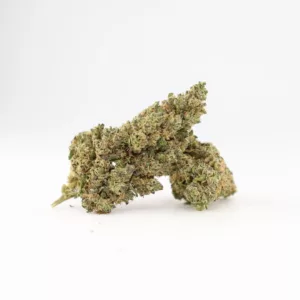
A CBD flower with purple hues immediately catches the eye. Amidst the green hues, its touches of violet, plum, or burgundy give it a distinctive visual identity. Trade names containing the word "Purple" reinforce this association and often raise the same questions: Is this coloration natural? Does it indicate a flower richer in CBD? Should we interpret it as superior quality?
The purple hues of hemp can come from natural pigments called anthocyanins. However, they are not a measure of CBD content. Research on cannabis pigmentation helps to understand this phenomenon, while also highlighting the importance of distinguishing appearance from product composition. pubmed.ncbi.nlm.nih.gov
When making your purchase, color may very well be a preference. It simply needs to be considered alongside other characteristics: advertised aromatic profile, flower size, batch information, and packaging price.
Discover the origin of purple CBD flowers, the limitations of visual interpretations, and useful criteria for comparing Buddha Farm’s CBD flowers.
Why are some CBD flowers purple?
The color of a plant depends in particular on the pigments present in its tissues. In the case of the red to purple hues of cannabis, anthocyanins play a significant role.
Anthocyanins are plant pigments
Anthocyanins belong to the flavonoid family. They contribute to the coloration of many plants and can be present in various hemp tissues.
A 2023 study, titled "When Cannabis sativa L. Turns Purple," investigated their accumulation in several vegetative and floral tissues. Researchers identified cyanidin-3-rutinoside, also known as keracyanin, as a major anthocyanin in the samples examined. pubmed.ncbi.nlm.nih.gov
You don't need to memorize this chemical name to choose your flower. The important point is to understand that a purple coloration can correspond to a natural botanical phenomenon.
The different parts of the plant are not the same
When you look at a photograph, take the time to identify what is colored. Do you see small leaves around the flower, floral tissues, or simply pistils with orange hues?
This distinction avoids describing an entire head as purple when only a few areas exhibit this hue.
To compare two references, an overall photograph and a precise description are more useful than a very close detail whose context remains difficult to understand.
A flower can display several shades at once
You can appreciate a presentation combining green, purple, and colored pistils. A flower doesn't have to be uniformly purple for this characteristic to contribute to its appearance.
If visual appeal is important to you, look for a description of the actual product. A phrase like "purple hues" doesn't convey the same presentation as a photograph showing a very pronounced color across the entire flower.
What role do genetics and the environment play?
Pigmentation is a characteristic studied both from the perspective of the plant and its development conditions.
Studies are examining the mechanisms of coloration
A 2024 publication in Plant Direct characterized anthocyanin biosynthesis in colored cannabis varieties. It contributes to a better understanding of the mechanisms associated with red and purple tissues.
This research focuses on specific biological characteristics. It does not constitute a classification of all flowers marketed under the name "Purple." pmc.ncbi.nlm.nih.gov
For your purchase, therefore, remember a simple distinction: the colour potential studied in a plant and the description of a commercial reference are not two identical pieces of information.
Temperature is also being researched
A study published in 2025 examined a cannabis population with relatively uniform purple pigmentation. Researchers studied anthocyanin accumulation, inflorescence dry mass, and total CBD content under different temperatures.
The results show that these parameters do not share the same temperature optimum. The authors also emphasize the importance of maturity in interpreting certain observations. These conclusions pertain to the studied population and protocol. pubmed.ncbi.nlm.nih.gov
It would therefore be excessive to reduce all purple flowers to a single explanation such as "they were simply cold".
Color does not tell the whole story of the production process
When faced with a purple flower, you cannot reconstruct the exact growing conditions by eye alone.
If you wish to know its origin or production environment, look for explicit information on the product sheet. Color does not replace this information.
This method prevents you from attributing a specific history to a product whose appearance is all you know.
Does a purple CBD flower contain more CBD?
This is probably the most important misconception to dispel in your comparison.
Pigmentation and advertised content should be read separately
A striking color might pique your interest in discovering a particular product. However, to determine its stated content, consult the relevant data and available documents.
The CBD.fr blog also points out that purple flowers can have varying concentrations of CBD and that green flowers can be rich in CBD. Its recent article on hemp colors clearly distinguishes between pigmentation and composition. CBD Blog
Your reading of the document will therefore benefit from separating two questions:
- What visual presentation is being announced?
- What composition information is provided?
These answers complement each other, but do not replace each other.
A photograph does not measure a percentage
Even a very sharp image doesn't provide analytical value. Strong contrast, visible details, and careful presentation make discovery enjoyable, but don't allow you to calculate the composition.
If the rate plays an important role in your choice, check how it is presented and what reference it relates to.
Avoid supplementing missing data with a visual impression.
The rate also doesn't encompass your entire preference
You can choose a flower based on its size, its advertised aromatic profile, or its price. The percentage is one piece of information among those that guide your decision.
The goal is to find an offer whose characteristics suit you, with sufficiently clear data.
Do purple flowers have a particular fragrance?
The word "Purple" can evoke fruit, floral notes, or a specific sensory identity. To choose, it's best to look at the description of each product.
Don't deduce the scent from the name
A brand name can be evocative. It does not replace the aromatic notes described in the product information sheet.
If you're looking for a woody, floral, or fruity fragrance, use these criteria to refine your selection. You can then consider color as an additional element.
This approach prevents you from ordering a product based solely on an association of ideas.
Distinguish between a sensory description of an ingredient
A mention of red berries or violets describes a fragrance profile. It does not prove the presence of those ingredients.
To find out the wording or any declared additions, consult the information provided for this purpose.
This will allow you to appreciate the aromatic vocabulary without attributing to it a scope it does not have.
Specify your preferences
If you've already enjoyed a particular fragrance, note the characteristics you liked. A query like "I'm looking for a floral and woody profile" provides a more useful guide than a search limited to "a purple flower.".
You will be able to discover products that match your tastes, including in different visual presentations.
What does "Purple" mean on a product page?
The word may be part of the name of a variety, a reference, or a commercial presentation. Its meaning must be understood within the context of the offer.
The name identifies a reference
It helps you find the product in a catalogue. To find out what the sachet contains, then read the description: format, weight, advertised characteristics and available information.
At Buddha Farm's, you can consult the Purple Small Buds CBD to discover the presentation of this product and check its current conditions.
The link between the name and the characteristics must be established by the record itself.
The name does not replace a description of the lot
If appearance is particularly important to you, ask if the visuals are representative of the product being offered.
A specific question will elicit a more useful answer than an implicit expectation based solely on the name.
You can also ask what an expression like "purple reflections" or "purple touches" in the description means.
Similar names should still be compared separately
Two names containing "Purple" are not sufficient to establish the equivalence of the products.
Examine the information in each offer. This will allow you to distinguish any differences in format, presentation, or advertised composition.
How to view a photograph of a CBD flower
Photos are an important aid for online shopping. It is beneficial to analyze them methodically.
Start with the overview
A close-up shows detail, but can make it difficult to judge the size. Check if the image shows a whole flower, several buds, or just a colored area.
Next, check the format specified in the text.
This reading allows you to understand what the image actually illustrates.
Keep the shooting conditions in mind
The lighting, contrast, and display of your screen influence your perception of colors.
Therefore, a visual difference between a photograph and direct observation does not have a single explanation.
If you wish to compare a color upon receipt, use neutral light and describe the observed nuances without intentionally altering the contrast of your own photo.
Separate the marketing visuals from the verifiable information
An image might illustrate a reference, while another might simply serve to present a blog theme. Their roles are not identical.
When making your purchase, rely on the product images and description. An editorial illustration, like the one in this article, is not a contractual photograph of a Buddha Farm's batch.
Natural purple flower or added coloring: what can be checked?
The presence of natural pigments in hemp is documented. However, this does not allow for verification of the history of any product based on a photograph.
First, look for clarity in the offer
Examine the nature of the product, its stated composition and any indications of processing.
If you are looking for a flower with no declared additives, explicitly state this expectation to the seller.
A documented response provides more than a judgment based solely on the intensity of the color.
Avoid home tests presented as universal
An impromptu test does not become a reliable method of identification simply because it produces a visible change.
Before interpreting a result, one should know what the test measures and what it actually distinguishes.
For your purchase, prioritize traceability and information from the professional rather than an experience whose scope remains unknown.
Ask a specific question if you are unsure
You can ask: "Is this item listed as a single flower, and what additions, if any, are declared?"
If your question concerns the color of the batch, please also specify what you observe and attach a representative photograph.
This will facilitate a response related to the product in question.
Does colour allow us to know the cultivation method?
The terms indoor, greenhouse and outdoor address a different question of pigmentation.
A crop category must be indicated
To find out the advertised production environment, consult the datasheet rather than trying to deduce it from a color.
You can explore indoor and Cali CBD flowers or the greenhouse, then compare the options according to your preferences.
Each category contains information to be read separately from the color.
Avoid automatic visual rankings
A darker or more contrasting flower may appear more elaborate. This impression alone is not enough to determine its cultivation method.
To appreciate the offer, go back to the elements announced: format, origin when specified, composition and packaging.
Your comparison will therefore be based on identified information.
Purple flowers and small buds: two distinct characteristics
A small flower may interest you for its size, while a purple shade relates to its visual presentation.
The caliber deserves its own reading
Check if the bag contains small buds, mixed sizes, or a homogeneous selection.
The baby buds and small buds CBD category allows you to locate this format in the Buddha Farm's catalogue.
Next, compare the characteristics of each reference, without letting color dominate the entire decision.
Choose according to what matters to you
If you are looking for large heads for their presentation, small caliber may be secondary in your selection.
If your priority is budget, a small flower offer is worth considering with its own information.
The color can remain a visual pleasure in both cases.
How to compare the price of purple CBD flowers?
A color can be part of a product's commercial appeal. To decide if the price is right for you, use comparable benchmarks.
Calculate the price for the selected weight
Divide the packaging price by its weight in grams.
In a hypothetical example, a 5g sachet at €25 costs €5/g. A 10g sachet at €40 costs €4/g.
The second option has a lower unit price but requires a higher total expenditure. Both figures are important in your decision.
Compare similar formats
A selection of large buds and small buds do not constitute the same commercial presentation.
First identify the product that interests you, then compare prices within that range.
You will avoid choosing a cheaper offer that does not match the format you are looking for.
Only pay extra for what interests you
If color is an important factor for you, it may influence your choice. However, make sure that the rest of the offer meets your expectations.
You can also browse the selection of low-priced CBD to broaden your comparison before deciding.
A simple method for choosing your flower
You can organize your search into five steps.
1. Define your priority
Do you primarily want a particular presentation, a specific aromatic family, or a precise budget?
Choose your primary criterion before browsing the references. This will give you a stable point of reference when faced with the most appealing photographs.
2. Identify the product
Read the name, format, and composition as stated. Verify that you understand the exact nature of the product.
The name "Purple" should be included in this reading, without replacing the other elements.
3. Examine the batch information
When documents are available, check their identification and their correspondence with the product.
Also check the parameters actually examined. An analysis should not be given a scope greater than that of its results.
4. Compare the presentation and the advertised fragrance
Keep a few references in mind whose descriptions match your preferences.
This will allow you to appreciate the color among several concrete characteristics.
5. Check the final amount
Select your paper weight, review applicable discounts and check any potential fees.
For a first discovery, choose a quantity consistent with your budget and level of confidence.
What should you do if you are surprised by the appearance you received?
Start by comparing the product to the description and format ordered.
Describe the discrepancy without assuming its cause
Indicate what you observe: less pronounced nuances, difference in caliber or unusual presentation.
This description will be more useful than an immediate conclusion about culture or preparation.
Keep your order information
Keep the reference, weight and batch identification when it appears on the packaging.
This information will allow customer service to locate the product in question.
Request a suitable clarification
You can ask if the observed appearance corresponds to the lot offered and if the visuals are representative.
A detailed exchange allows us to address your question on a concrete basis.
Frequently asked questions about purple CBD flowers
Why does a CBD flower turn purple?
Anthocyanins are among the pigments responsible for the purple hues of hemp. Studies are examining their presence and accumulation mechanisms. For commercial reference, a product description is still required.
Is a purple flower richer in CBD?
Color does not provide analytical value. Consult the stated content and relevant documents to compare the composition.
Are all references containing "Purple" very purple?
The name alone doesn't tell you what the product will look like. Look at the description and images, then ask for clarification if color is your main criterion.
Does color allow us to predict the scent?
To choose an aromatic profile, use the notes listed in the description. Avoid deducing a fragrance solely from its name or color.
Is a green flower less interesting?
Your preference may be based on other criteria: format, advertised fragrance, documentation, or price. Compare the options according to your needs.
Can the absence of additives be certified using a photograph?
A single image doesn't tell the whole story of a product. Look for a clear composition and ask the seller a question if this is important to you.
Can small flowers be called Purple?
Yes, the caliber and the reference name answer two separate questions. Check the product sheet for the exact product description.
Should we choose a flower solely for its appearance?
You may appreciate its color, but your decision benefits from taking into account the advertised composition, format, batch information, and total budget.
Discover CBD flowers with criteria that suit you
The purple hues add a visual dimension to the hemp discovery experience. You can appreciate them while still having a clear understanding of the offer.
Start by defining your preferences, then compare the information specific to each item. A photograph catches your eye; the description, format, and documentation help you decide.
Explore Buddha Farm’s CBD flowers or check out the Purple Small Buds CBD product to discover its current characteristics. Your choice will be more consistent if the color meets your criteria, along with a suitable quantity and a clear budget.
Sources and further reading
- When Cannabis sativa L. Turns Purple: Biosynthesis and Accumulation of Anthocyanins, 2023.
- Leaf pigmentation in Cannabis sativa: Characterization of anthocyanin biosynthesis in colorful Cannabis varieties, Plant Direct, 2024.
- Anthocyanin accumulation, inflorescence dry weight and total cannabidiol content have different optimum temperature in Cannabis sativa, 2025.
- CBD.fr — Why some hemp flowers turn purple, red, or gold, November 2026.