


CBD may relieve some women's menstrual pain, but there is no solid clinical evidence to support its widespread effectiveness. Anecdotal surveys show positive results, but these should not replace a medical diagnosis, especially if endometriosis is suspected. The following explains the possible mechanisms, the current state of evidence, methods of use, and precautions to be aware of before trying CBD for menstrual pain.
In short:
- Clinical data on the effectiveness of CBD against menstrual pain remain limited, relying mainly on subjective self-reported surveys.
- The proposed mechanisms involve indirect modulation of CB1, CB2 and TRPV1 receptors, as well as possible partial inhibition of the COX-2 enzyme, but nothing has been confirmed in humans.
- No double-blind controlled trial has validated CBD as an effective treatment for dysmenorrhea, unlike conventional anti-inflammatories such as ibuprofen.
- The dosage and form of CBD should be experimented with over several cycles, keeping a journal, to avoid a biased reaction or a simple natural fluctuation of the cycle.
- Pharmacological caution dictates consulting a professional if the treatment is accompanied by drugs metabolized by the liver or in the case of specific medical conditions.
Table of Contents
- How CBD works on menstrual pain and inflammation
- What do studies actually say about CBD and menstrual pain?
- What forms of CBD should I try for period pain?
- CBD and painful periods: what safety precautions should be checked?
- How to recognize a reliable CBD product for your period?
- Why trust this guide on CBD and painful periods?
- Things to know before trying CBD during your period
- Discover Buddhafarms products to support your cycle
- Sources
- Frequently Asked Questions
How CBD works on menstrual pain and inflammation
The human body possesses an endocannabinoid system, a network of receptors that regulates pain, inflammation, and mood. Two receptors play a central role in this process: CB1, found primarily in the nervous system, and CB2, more closely linked to immune cells. CBD does not act directly on these receptors like THC; rather, it modulates their activity and also interacts with the TRPV1 receptor, which is involved in the perception of pain and heat.
The most common hypothesis to explain an effect on menstrual cramps concerns prostaglandins. These are substances produced by the uterus that trigger the contractions responsible for period pain. In vitro data suggest that certain cannabinoids could interfere with the production of these prostaglandins and with the COX-2 enzyme, the same one targeted by conventional anti-inflammatory drugs like ibuprofen, according to the mechanisms described by Medical News Today.
Key points to remember about these mechanisms:
- CB1 and CB2 receptors are involved in the regulation of pain and inflammation, but CBD modulates them indirectly.
- TRPV1 is involved in the sensation of pain and could be one of the entry points for the action of CBD.
- The partial inhibition of COX-2 observed in the laboratory remains a possibility, not a demonstration in humans.
- Animal models and cellular studies give results consistent with this hypothesis, without allowing us to conclude that there is clinical efficacy.
These mechanisms therefore remain plausible, but not proven. They explain why researchers are interested in CBD for menstrual pain, but laboratory biology never guarantees the same effect in a woman who takes sublingual oil on the first day of her period.
What do studies actually say about CBD and menstrual pain?
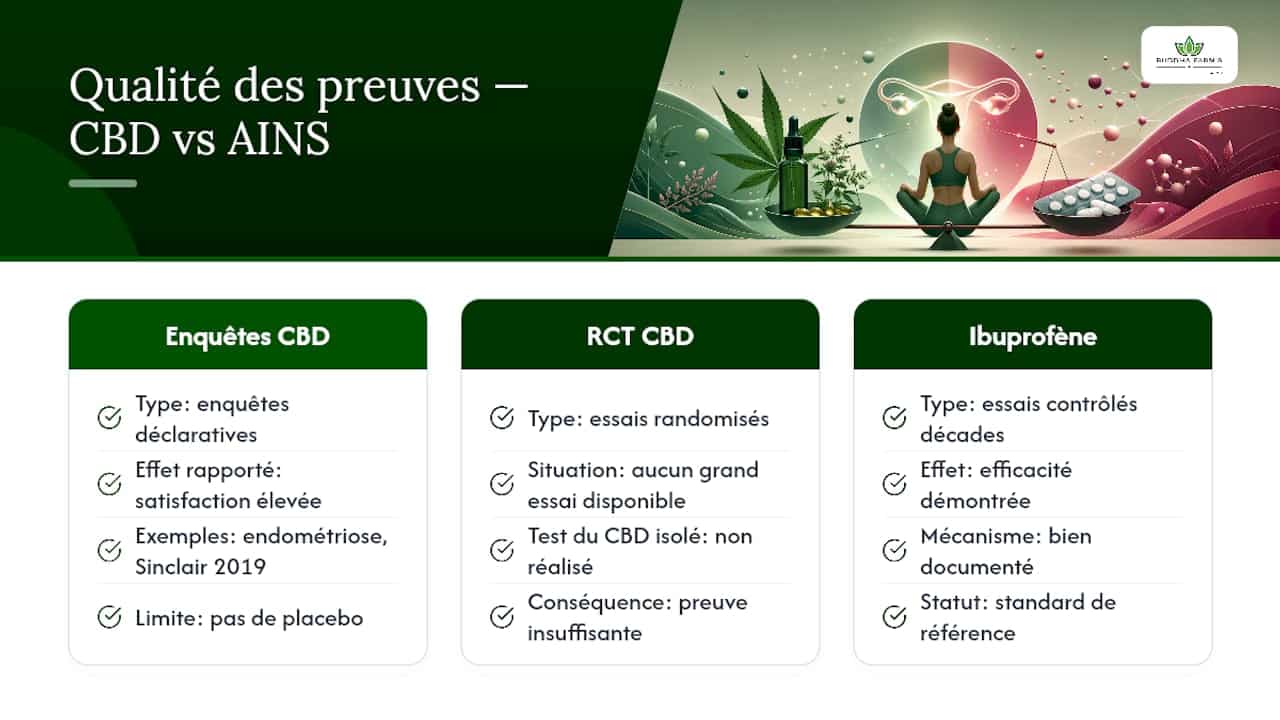
Existing data relies almost exclusively on self-reported surveys, where participants describe their experiences. An Australian survey of women with endometriosis showed that many patients using medical cannabis reported a reduction in pelvic pain. Another study, by Sinclair and colleagues published in 2019, surveyed women using cannabis for menstrual symptoms: a majority rated the effect as moderate to strong, as reported in Chirurgie Gynécologie.
What these figures reveal is that high satisfaction rates in self-reported surveys are not proof of clinical efficacy. These studies do not compare to a placebo and rely on the participants' subjective recollections, a well-known bias in research.
This type of data has significant methodological limitations. The women who respond to these surveys are often already convinced of the benefits of cannabis, which artificially inflates the positive results. To date, no large-scale, double-blind, randomized trial has tested isolated CBD against a placebo for dysmenorrhea, a point confirmed by the reviews available on PubMed.
By comparison, nonsteroidal anti-inflammatory drugs (NSAIDs) like ibuprofen have decades of controlled clinical trials demonstrating their effectiveness on menstrual pain, with well-documented mechanisms of action. CBD does not yet have this level of validation. This does not mean that it doesn't work for some women, but rather that scientific caution dictates that it should not be presented as a proven equivalent to conventional treatments.
What forms of CBD should I try for period pain?
Several formats exist, each with a different speed of action and use. Sublingual oil, placed under the tongue, passes directly into the bloodstream and generally takes effect within 15 to 45 minutes, making it an option for addressing pain at its first signs. Topical products and balms are applied locally to the lower abdomen or lower back, a promising approach for localized rather than diffuse pain. Patches release CBD gradually over several hours, while capsules and suppositories offer a slower but potentially longer-lasting effect.
None of these methods has demonstrated superiority over the others for dysmenorrhea. The choice depends primarily on the type of pain and each woman's lifestyle.
Here is a progressive testing method to follow over several cycles:
- Start with a low dose, around 5 to 10 mg, one or two days before the expected arrival of menstruation.
- Gradually increase the dose if no effect is felt after two or three cycles, without exceeding the manufacturer's recommendations.
- Note the intensity of the pain, its duration, and any possible side effects in a simple journal.
- Compare your notes over three to four cycles before drawing a conclusion, as the intensity of periods naturally varies from month to month.
Pro tip: Keeping a monthly pain diary, rating your pain out of ten, helps distinguish a genuine effect of CBD from a simple natural fluctuation in your cycle. Without this tracking, it's nearly impossible to know if the product is actually working for you.
To understand why some forms act faster than others, our article on CBD bioavailability details the differences in absorption depending on the method of administration.
CBD and painful periods: what safety precautions should be checked?
CBD is not without pharmacological effects. It inhibits certain liver enzymes called cytochrome P450, the same enzymes that metabolize many common medications. This interaction can alter the blood concentration of some treatments, sometimes with serious consequences.
Situations that require medical advice before any trial:
- Taking anticoagulants, as CBD may increase their concentration and the risk of bleeding.
- Antiepileptic treatment, a documented interaction that may require dose adjustment.
- Some antidepressants are metabolized by the same liver enzymes as CBD.
- Pregnancy and breastfeeding are periods for which safety data remains insufficient.
- The appearance of unusual drowsiness, persistent digestive problems or marked mood changes after taking the medication.
The World Health Organization has generally classified CBD as having a favorable safety profile, while acknowledging the lack of data for many specific indications. This assessment does not replace a discussion with your doctor, especially if you are on chronic medication. Never stop a prescribed medication and replace it with CBD without first consulting a healthcare professional. Our page on CBD interactions with certain medications details this enzyme inhibition mechanism in more detail.
How to recognize a reliable CBD product for your period?
All CBD oil sold in France must be accompanied by a Certificate of Analysis (COA) issued by an independent laboratory. This document indicates the actual concentration of cannabinoids and the absence of contaminants such as pesticides, heavy metals, or residual solvents.
Points to check before making a purchase:
- The certificate of analysis must be accessible and recent, not a generic document taken from another batch.
- The THC level must remain within the legal limit in force in the European Union.
- The origin of the hemp and the extraction method must be specified, with supercritical CO2 extraction generally considered the cleanest.
- The format should correspond to the symptom: sublingual oil for a global effect on the body, topical balm for localized lower abdominal pain.
Avoid platforms that don't provide any information about the traceability of their products. A reputable CBD product for menstrual pain never relies on marketing promises; it provides documented evidence. The comprehensive guide to CBD oils details the selection criteria in more detail. Finally, it's important to note that no CBD product currently has marketing authorization as a medication for painful periods in France: the products sold remain food supplements or cosmetics, never treatments in the regulatory sense.
Why trust this guide on CBD and painful periods?
The company works with organic hemp, with a strong emphasis on the traceability of all products sold, whether oils, flowers, or cosmetics. This approach directly informs how we address the topic of menstrual pain.
- Each CBD product offered is selected according to criteria of legal compliance and verifiable quality.
- Our content draws on in-depth resources, such as our dossier on the therapeutic effects of CBD, to go beyond simple marketing claims.
- We consistently remind people that severe or unusual menstrual pain warrants a medical consultation, as CBD is never a substitute for a diagnosis.
This rigor does not replace a clinical opinion; it only aims to give you honest information so you can make an informed decision.
Things to know before trying CBD during your period
There are many positive testimonials about CBD and menstrual pain, but they don't replace rigorous clinical validation. Document your experience over several cycles before drawing any conclusions, and talk to your doctor if the pain persists or worsens. The quality and transparency of products are just as important as the decision to try them or not.
— Fred
Discover Buddhafarms products to support your cycle
Buddhafarms offers a range of sublingual oils and topical balms selected for their traceability, with each batch accompanied by a certificate of analysis from an independent laboratory. The hemp used is cultivated according to organic standards, as this source demonstrates , and the THC levels comply with current regulations—a useful indicator when seeking a reliable product rather than a vague promise.

If you're looking for an oil for daily sublingual use, the CBD oil guide outlines the available concentrations and their uses. For more localized pain, a topical balm can be applied directly to the lower abdomen. Consult the product sheets to compare concentrations, or contact our customer service team to be directed to the format best suited to your needs.
Sources
- CBD and menstrual pain: what does science say? – Gynecological Surgery
- CBD for menstrual cramps — Medical News Today
- PubMed – a reference related to cannabinoids and pain
Frequently Asked Questions
Does CBD relieve pain associated with endometriosis?
Some women with endometriosis report relief, with an Australian survey noting that 60% of medical cannabis users experienced a reduction in pelvic pain, according to Gynecological Surgery. However, this data remains self-reported and does not replace gynecological care, as endometriosis requires a precise medical diagnosis.
What are the effects of CBD on a woman's body during her period?
CBD interacts with the endocannabinoid system and may modulate prostaglandin-related inflammation that causes cramps. Reported effects include muscle relaxation and a reduced perception of pain, but the extent of this effect varies considerably from person to person.
Can CBD really relieve pain?
CBD acts on receptors involved in pain perception, particularly TRPV1, which explains the effect reported by many users. However, no large-scale, double-blind, randomized controlled trial has yet confirmed its effectiveness for dysmenorrhea.
How to quickly relieve severe period pain?
Anti-inflammatory drugs like ibuprofen remain the best-documented treatment for severe pain, with a proven effect on prostaglandin production. CBD, in sublingual oil taken at the first signs, can be a complementary option to try over several cycles, but should not replace medical advice in cases of unusual or debilitating pain.
How long does it take to determine if CBD is working on my period?
A thorough trial typically requires three to four menstrual cycles, with a diary noting the intensity and duration of pain each time. For pricing information on CBD oils and balms, please consult the product pages on the website.


