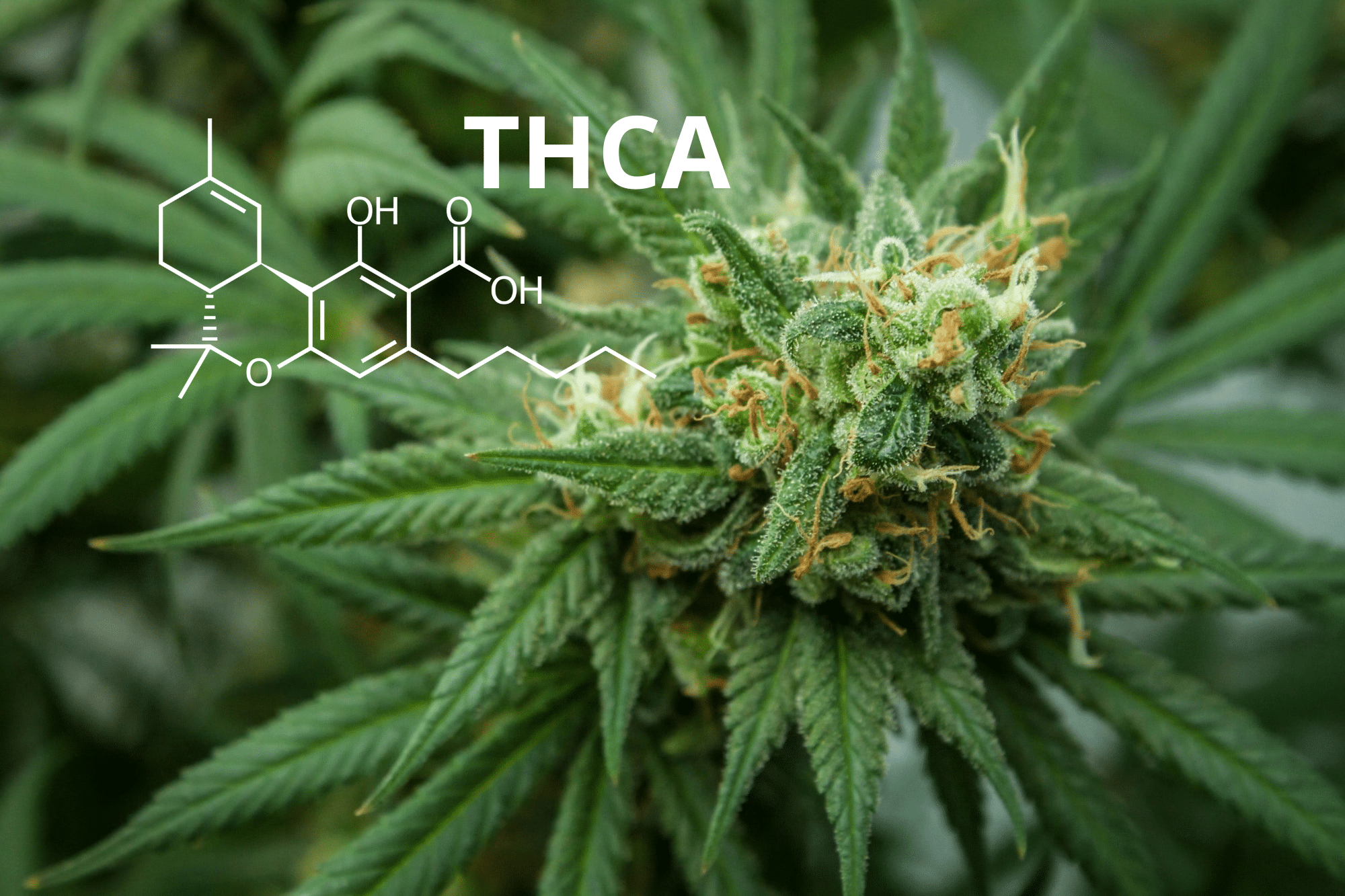
THCA, or tetrahydrocannabinolic acid, is a cannabinoid found in the cannabis plant that is generating increasing interest in discussions about its potential applications, both in the health field and in the cannabis products industry. Unlike THC, well-known for its psychoactive effects, THCA is a non-psychoactive compound. It does not produce the feeling of euphoria often associated with cannabis use, but it possesses properties that could have interesting therapeutic benefits.
In the cannabis plant, THCA occurs naturally in its raw form. It is found primarily in fresh cannabis flowers, but also in other parts of the plant. In its natural state, it has no intoxicating effect, but when heated, for example when smoking or vaporizing, it transforms into THC, a compound known for its psychoactive effects. This chemical transformation, called decarboxylation, is at the heart of the interest in THCA in certain circles, particularly among consumers seeking to maximize the psychoactive effects of THC while having access to legal products, especially in European countries.
Difference between THCA and THC
One of the main differences between THCA and THC lies in their effects on the human body. Raw THCA produces no psychoactive effects. It is often consumed for its potential therapeutic benefits, without causing the euphoric state sought by some cannabis users. However, when THCA is heated, it undergoes a chemical reaction that transforms it into THC (tetrahydrocannabinol), which is responsible for the psychoactive effects such as the feeling of being "high.".
The decarboxylation of THCA into THC occurs at relatively low temperatures, which is why THCA is often consumed in the form of flowers or concentrates that are then vaporized or smoked. This process allows the full potential of THC to be released and produce the effects desired by users. For those seeking only the therapeutic benefits of cannabis without its psychoactive effects, consuming THCA in its raw form, such as in raw cannabis juices or patches, can be a viable option.
Forms of THCA available
THCA is available in various forms on the market, each with its own uses and methods of consumption. Here are the main ones:
- Cannabis flowers rich in THCA : Cannabis flowers naturally contain THCA. These flowers are often sold under the label "hemp" when they meet the legal limit of 0.3% THC in several countries, including France. These flowers can be consumed raw for their potential therapeutic benefits, or vaporized to cause decarboxylation and release THC.
- THCA crystals (or THCA diamonds) : THCA crystals are obtained through a complex extraction process that isolates and purifies THCA into small, translucent crystals. These THCA "diamonds" are popular among cannabis users seeking a high concentration of THC after decarboxylation. Used particularly for dabbing, a vapor inhalation method, these crystals allow users to achieve very high levels of THC.
- THCA patches : Like nicotine patches, THCA patches deliver a controlled amount of THCA directly into the bloodstream. This form is often preferred by users seeking to experience the potential effects of THCA without smoking or vaping the substance, and without psychoactive effects.
- THCA Edibles : Edible products containing THCA, such as gummies or capsules, are another way to consume this cannabinoid. However, it's important to note that the cooking process can sometimes lead to the partial decarboxylation of THCA into THC, which could produce mild psychoactive effects.
The effects and therapeutic potential of THCA
Although raw THCA does not produce a psychoactive effect, preliminary research suggests it may have several therapeutic benefits. Studies in animal models and, to a lesser extent, in humans, have suggested that THCA may have anti-inflammatory, anti-nausea, and anticonvulsant effects. Some researchers are also investigating its neuroprotective potential, particularly in the treatment of neurodegenerative diseases such as Parkinson's and Alzheimer's.
Due to its non-psychoactive nature, THCA could be an attractive option for consumers seeking the benefits of cannabis without the altered state of consciousness. It could thus help relieve chronic pain, reduce inflammation, or alleviate symptoms related to gastrointestinal disorders. However, it is important to emphasize that research on THCA is still in its early stages, and more clinical studies are needed to better understand its effects and efficacy in humans.
Legality of THCA in France and Europe
THCA, as a non-psychoactive compound, occupies a special place in European legislation. In France, for example, the law on cannabinoids is based on strict regulations concerning THC, but THCA is not explicitly prohibited as long as it is sold in products that comply with the legal THC threshold of 0.3%. This means that products containing THCA, such as flowers or concentrates, can be marketed as long as they respect this limit.
This legal distinction allows consumers to legally obtain THCA without violating controlled substances laws. However, it is crucial to understand that THCA can be converted into THC simply by heating it, which could create a legal gray area, especially if the product is used to generate THC concentrations exceeding the legal limit.
At the European level, regulations vary from country to country, but the European Union generally tolerates the presence of THCA in hemp products, as long as they comply with the imposed THC content limits. For French and European consumers, this opens the door to the use of THCA in various forms without risking a violation of local laws, provided that the THCA is used in its raw and unprocessed form.
Risks and side effects of THCA
As with all cannabinoid compounds, THCA can present some risks, although these are generally less severe than those associated with THC. In its raw form, THCA does not cause intoxication, but it can still lead to side effects such as nausea, gastrointestinal upset, or skin rashes in some individuals. Furthermore, some studies have shown that THCA may interact with certain medications, which should be taken into account by people undergoing specific drug treatments.
The main risk associated with THCA lies in its conversion to THC when heated. Smoking or vaporizing THCA to obtain THC can lead to side effects similar to those of THC, such as relaxation, altered perception, memory problems, or an increased heart rate. In extreme cases, excessive THC consumption can cause panic attacks or hallucinations, particularly in individuals sensitive to the cannabinoid.
Finally, it's also important to mention that, as with any cannabis-derived product, the quality and purity of THCA can vary considerably from one product to another, especially in a market that is still relatively young and rapidly expanding. It is therefore recommended to choose products from reliable sources, with supporting laboratory analyses to guarantee the absence of contaminants.
Future prospects and research on THCA
THCA represents a growing area of interest for researchers and healthcare professionals. Its potential effects on inflammation, chronic pain, and neurodegenerative diseases offer exciting prospects for alternative treatments. However, it is crucial that clinical research in humans continues to accurately determine the therapeutic applications of THCA and its long-term efficacy.
In a booming European market for cannabinoid products, THCA could become a preferred product for those seeking the benefits of cannabis without the psychoactive effects. Companies specializing in CBD and legal cannabinoids have already begun offering THCA-based products in the form of flowers, concentrates, and edibles. As regulations become more flexible and research progresses, THCA is likely to play an increasingly important role in the cannabinoid industry in France and across Europe.
In conclusion, THCA represents a promising component of cannabis, with a wide range of possible therapeutic applications.