

CBD shows real promise for anxiety and sleep disturbances related to menopause, two symptoms for which clinical observations exist. For hot flashes, the evidence remains insufficient, and The Menopause Society does not currently recommend cannabinoids . Medical advice is still necessary before use, especially if you are currently undergoing treatment.
In short:
- A clinical study conducted with 72 patients found less anxiety after one month; the improvement in sleep was less stable at three months.
- For hot flashes, The Menopause Society does not recommend cannabinoids; hormone therapy, certain antidepressants, or gabapentin have better evidence.
- CBD acts on liver enzymes that metabolize many medications, including some hormone treatments, antidepressants and anticoagulants; medical advice is necessary.
- To assess potential benefit, start with a low dose and note your symptoms for two to four weeks; also check the product's certificate of analysis.
Table of Contents
- Perimenopause and menopause: what symptoms to try to relieve
- What studies show for each symptom
- What learned societies recommend today
- Safety, interactions and precautions to know
- Forms of CBD and methods for assessing its effect
- How to recognize a reliable CBD product
- Fred and Buddha Farm's: an approach based on traceability
- What is a realistic role for CBD in menopause?
- Our CBD products to support your everyday comfort
- Frequently Asked Questions
- Sources
Perimenopause and menopause: what symptoms to try to relieve
Perimenopause refers to the hormonal transition phase that precedes the cessation of menstruation, often marked by irregular cycles and the first vasomotor symptoms. Menopause, on the other hand, is defined as the absence of menstruation for twelve consecutive months. Between these two events, some women experience several years of discomfort before their bodies stabilize.
The symptoms that most often lead people to seek a natural solution are well-known: hot flashes and night sweats, sleep disturbances, mood swings and anxiety, muscle or joint pain, vaginal dryness, and, in the longer term, bone loss. Each of these symptoms has a different origin, which explains why no single solution covers them all.
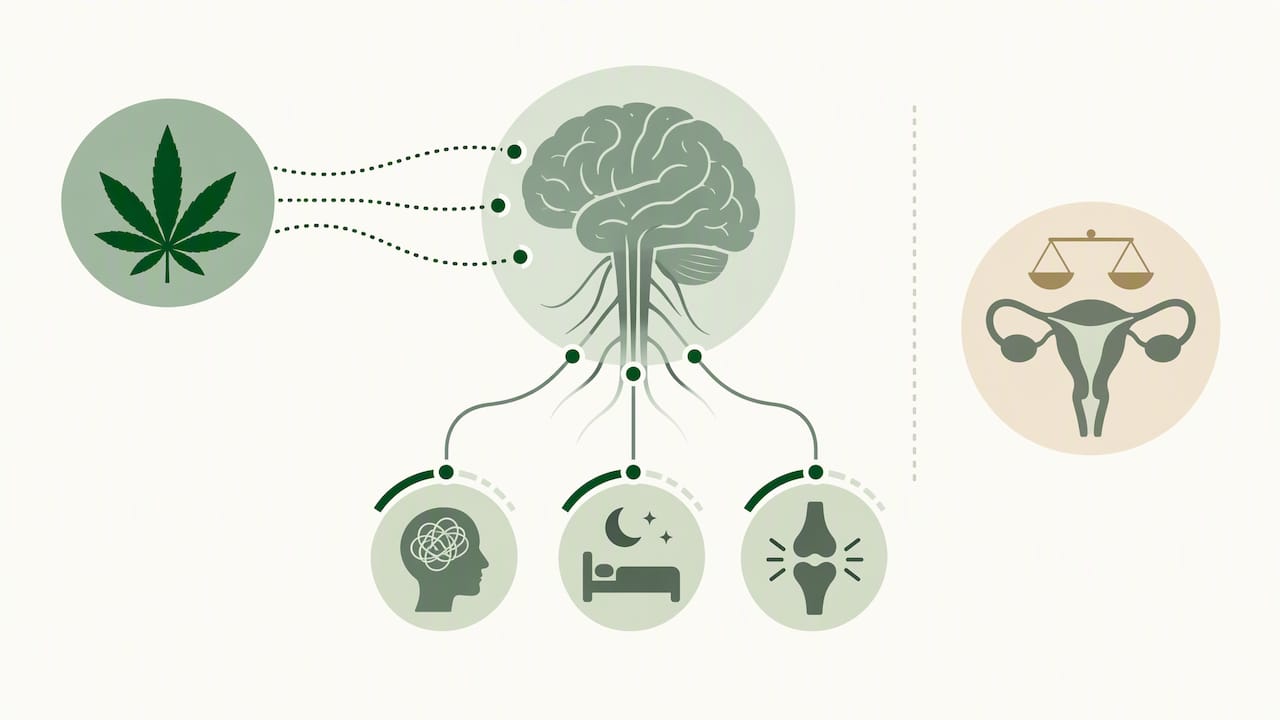
It is precisely because cannabidiol acts on mechanisms related to anxiety, sleep regulation, and pain perception that it is of interest to menopausal women. The idea is not that it corrects the hormonal imbalance itself, but that it could mitigate some of the consequences of this imbalance on the nervous system.
What studies show for each symptom
The available evidence is not uniform. Some avenues are documented by clinical observations, others are based solely on animal models, and one remains clearly dismissed by learned societies.
- Anxiety : A 2019 clinical study of 72 patients reported that the majority of participants experienced a decrease in their anxiety after one month of using CBD, a relevant finding for women who experience anxiety as one of the most distressing symptoms of the menopausal transition.
- Sleep : the same study observed an improvement in sleep in a large proportion of participants in the first month, but this effect was less stable at three months, which suggests caution regarding the actual duration of the benefit.
- Pain and inflammation : the available data on the anti-inflammatory mechanisms of CBD remain mostly preclinical; clinical trials specific to musculoskeletal pain of menopause are lacking.
- Hot flashes : there is insufficient evidence to confirm an effect, and The Menopause Society lists cannabinoids among the non-recommended options for vasomotor symptoms in its 2023 position.
- Bones and osteoporosis : the data remain confined to preclinical research, without conclusive clinical trials in humans at this stage.
To explore two of these avenues in more depth, our pages dedicated to CBD and anxiety and CBD and insomnia detail the mechanisms discussed in the literature. Regarding hot flashes, our article on hot flashes and CBD provides a more in-depth look at the position of learned societies.
What learned societies recommend today
The Menopause Society's position, published in 2023, is clear on one point: cannabinoids, including CBD, are not among the recommended treatments for hot flashes and night sweats due to a lack of robust and consistent evidence. This position specifically addresses vasomotor symptoms, not all potential uses of CBD for menopausal women.
For hot flashes, several options have a much higher level of evidence:
- Hormone replacement therapy (HRT) is often considered the gold standard for moderate to severe vasomotor symptoms.
- SSRI antidepressants, used especially when HRT is not indicated.
- Gabapentin, sometimes prescribed as an alternative, particularly for night sweats.
- Fezolinetant, a more recent option specifically targeting thermal regulation.
CBD occupies a different place: that of a potential support for general comfort, particularly regarding anxiety and sleep, without replacing approved treatments when these are indicated. Discussing it with a doctor before starting remains the best way to avoid interrupting effective treatment in favor of a solution whose effect on hot flashes is not proven.
Safety, interactions and precautions to know
CBD is not a pharmacologically inert substance, and it is precisely for this reason that it deserves to be used judiciously. Data on CBD drug interactions show that it acts on liver enzymes of the CYP450 group, the same enzymes that metabolize many common medications.
- Antidepressants, certain menopausal hormone treatments, and anticoagulants are among the drug classes where an interaction is possible.
- Elevations in liver enzymes have been documented in clinical use, which justifies biological monitoring in case of prolonged or high dose intake.
- The FDA information leaflet for EPIDIOLEX, a cannabidiol formulation approved for certain epileptic syndromes, mentions drowsiness and sedation as possible side effects.
- Mood swings or reduced alertness may occur, which calls for caution before driving or consuming alcohol at the same time.
Pro tip: Always inform your doctor about any CBD use, even occasional, especially if you are undergoing hormone therapy or taking an antidepressant.
Our page on CBD and drug interactions details the classes of medications to monitor more closely. Starting with a low dose and gradually increasing it, while monitoring the body's signals, remains the safest approach when taking multiple medications.
Forms of CBD and methods for assessing its effect
Not all forms of CBD behave the same way in the body. Oil taken under the tongue passes through the oral mucosa and generally acts faster than capsules or ingested products, which pass through the liver before reaching the bloodstream. Inhaled products offer a rapid onset of effect but a shorter duration, while topical products remain limited to local action, useful for targeted muscle pain rather than for anxiety or sleep.
To properly assess an effect, a gradual approach works better than a single trial:
- Start with a low dose, respecting the guidelines indicated on the product label.
- Keep a tracking journal for two to four weeks, noting sleep, frequency and intensity of anxiety, and pain level.
- Increase the dose gradually only if the effect remains insufficient after several days at a stable dose.
- Stop and consult a doctor if you experience marked side effects, including excessive drowsiness or persistent digestive problems.
Checking the product's Certificate of Analysis (COA) and the exact concentration in milligrams per milliliter indicated on the bottle allows for precise dosing, an essential condition for correctly interpreting your own observations. Our practical guide on CBD for sleep offers concrete guidelines for this testing phase.
How to recognize a reliable CBD product
Given the diversity of the offer, a few simple checks can help to eliminate the least reliable products before purchase.
- Require a recent Certificate of Analysis (COA), indicating the CBD level, the THC level and the absence of contaminants such as pesticides or residual solvents.
- Understanding the difference between full spectrum, broad spectrum and isolate, the choice depends on personal tolerance to THC and the desired objective.
- Opt for organic farming and CO2 extraction, which are generally associated with better traceability of the finished product.
- Read the product information sheet in detail to identify any additional ingredients, especially in flavored oils or food products.
For everyday wellness use, aiming for a moderate concentration at the start is more prudent than choosing a highly concentrated product by default.
Fred and Buddha Farm's: an approach based on traceability
This article is written by Fred, on behalf of a company specializing in organic hemp. Each product we offer is selected based on traceability and legal compliance, with available certificates of analysis. This rigorous approach also guides how we present the available scientific evidence, without misrepresenting what the research actually establishes.
What is a realistic role for CBD in menopause?
CBD should be considered a comfort aid, not a substitute for approved treatments when those treatments are indicated for hot flashes. The use of cannabis and cannabinoids is increasing among women over fifty, often for pain, anxiety, and sleep, but rarely specifically for vasomotor symptoms. Research is progressing, including on minor cannabinoids, and dialogue with a doctor remains the best way to adjust a decision as the data evolves.
— Fred
Our CBD products to support your everyday comfort
For women seeking sleep or relaxation support, we offer several product lines designed to meet different needs depending on the symptoms to be addressed.

- Our CBD oils are particularly suitable for sublingual use, which is convenient for testing a gradual dosage on sleep or anxiety.
- Our CBD flowers offer a fast-acting inhalation option for moments of passing tension.
- Our CBD extracts cater to those seeking a higher concentration.
- Our cosmetic targets localized pain and dry skin associated with menopause.
Each product comes with a certificate of analysis to verify its composition before purchase.
This article provides general information and is not a substitute for professional medical advice. Consult a qualified healthcare professional about your specific situation before taking any action based on this content.
Frequently Asked Questions
Does CBD really help with hot flashes?
Current evidence does not support this effect, and The Menopause Society classifies cannabinoids as not recommended for vasomotor symptoms. CBD, however, shows documented benefits for anxiety and sleep, two symptoms frequently associated with menopause.
How long before you feel the effects of CBD?
The first effects on anxiety and sleep were reported as early as the first month of use in a clinical study involving 72 patients. Keeping a follow-up diary for two to four weeks remains the best way to assess one's own experience.
Can CBD interact with my hormone treatment?
Yes, CBD affects liver enzymes that metabolize many medications, including some hormone treatments, according to available data on its interactions. It is advisable to inform your doctor before starting, especially if you are taking multiple medications.
Which form of CBD should I choose for sleep or anxiety?
Oil taken under the tongue generally acts faster than capsules because it bypasses the liver. Starting with a low concentration and gradually increasing it remains the safest way to judge its true effectiveness.
How to check the quality of a CBD product before buying?
Check for a recent certificate of analysis indicating the CBD and THC levels, as well as the absence of contaminants. Opting for organic cultivation and CO2 extraction generally provides a better guarantee of traceability.
Sources
- The Menopause Society position statement (2023) – nonhormone therapy
- Iffland & Grotenhermen, 2019 — Cannabidiol in clinical practice
- Drug interactions and liver safety of CBD
- EPIDIOLEX (cannabidiol) oral solution – FDA label (2018)


