
A neo-cannabinoid is a synthetic or chemosynthetic molecule designed to mimic the effects of THC, often with significantly greater potency. The main danger lies in the unpredictability of the dosage and the increased risk of serious poisoning. In France, the legal status remains fluid: the ANSM (National Agency for Medicines and Health Products Safety) regularly classifies new substances as narcotics, making some products sold yesterday illegal today.
In short:
- The majority of neo-cannabinoids are synthetic or geosynthetic substances with high toxicity, often unpredictable and more potent than natural THC.
- These molecules completely saturate CB1 receptors, causing intense and rapid effects, with an increased risk of seizures, psychosis, and death by intoxication.
- The French legal framework is evolving rapidly, classifying entire families of chemical derivatives en masse, making their possession illegal without a reliable certificate of analysis.
- Verification of an independent certificate of analysis is essential to distinguish a safe product, as contamination or uneven spraying of the molecule is common.
- Products guaranteed to be free of illicit neo-cannabinoids come mainly from traceable organic hemp with verifiable certifications.
Table of Contents
- What exactly is a neo-cannabinoid?
- What are the clinical effects and risks of neo-cannabinoids?
- Why are these molecules more powerful than THC?
- Neo-cannabinoids and French law: where do we stand in 2026?
- How to identify a risky product before buying it?
- What Buddhafarms guarantees regarding the traceability of its products
- What regulation will change for the market
- Prioritize traceable CBD products rather than obscure molecules
- Where did the information in this article come from?
- Sources
- Frequently Asked Questions
What exactly is a neo-cannabinoid?
The term refers to a heterogeneous family of molecules that partially or completely replicate the effects of delta-9-THC on the body without originating directly from the cannabis plant. Three distinct categories must be identified.
- Natural phytocannabinoids : present as such in the plant (THC, CBD, CBG), extracted without heavy chemical transformation.
- Geosynthetic cannabinoids : obtained by chemically modifying a natural molecule such as CBD, like HHC, H4CBD or THCP.
- Synthetic cannabinoids : created entirely in the laboratory, with no direct link to the plant, such as certain derivatives of HHCPO or modified THCV-type molecules.
These substances circulate in various forms, making them difficult for buyers to identify: e-cigarette liquids, crystalline powders, so-called "enriched" flowers where the molecule is sprayed onto legal hemp, and edibles such as candies or drinks. This diversity of formats largely explains why synthetic cannabinoids pose a different public health problem than traditional CBD: consumers almost never know what they are actually ingesting, or at what concentration.
What are the clinical effects and risks of neo-cannabinoids?
Field reports are unambiguous on one point: the effects of neo-cannabinoids far exceed those of traditional cannabis in intensity and unpredictability. Harm reduction centers report clinical presentations that go well beyond simple cannabis intoxication.
The key point to remember: some of these compounds have been directly linked to deaths from poisoning, a fact documented by risk reduction sheets on synthetic cannabinoids, which emphasize the greater toxicity of these molecules compared to that of natural THC.
The most frequently reported acute effects include:
- Severe tachycardia, sometimes accompanied by chest pain.
- Seizures, including in people with no history of epilepsy.
- Hallucinations and episodes of acute psychosis, sometimes lasting.
- Uncontrollable vomiting and rapid dehydration.
- Loss of consciousness or profound confusion requiring hospitalization.
What strikes field teams is less the nature of the symptoms than their severity: a consumer accustomed to CBD or traditional flowers can find themselves in a state they've never experienced before within minutes, with no apparent link to the quantity consumed. If you or someone around you experiences seizures, marked confusion, or a rapid heartbeat after consuming a questionable cannabis product, contact emergency services (15 in France) or the poison control center immediately: these types of poisoning often develop more rapidly than a seizure related to traditional cannabis.
Why are these molecules more powerful than THC?
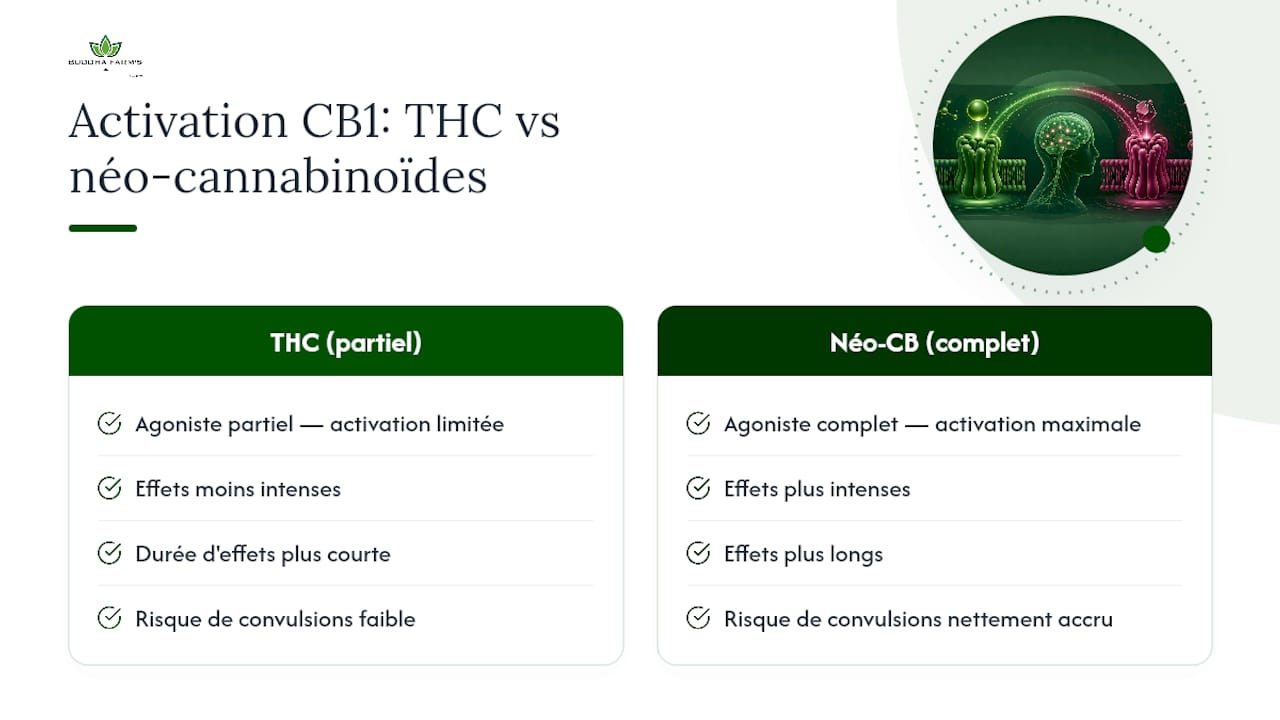
Natural THC acts as a partial agonist of the CB1 receptor, which regulates most of the psychoactive effects of cannabis in the brain. It occupies the receptor without ever activating it at full power, a kind of built-in biological brake.
Many neo-cannabinoids, however, behave as full agonists: they saturate the CB1 receptor and trigger a maximal response, without the natural safeguard of THC. In practical terms, this translates into more intense, longer-lasting effects, and a significantly increased risk of seizures or acute psychosis. The scientific literature on these compounds remains limited and fragmented, which necessitates additional caution: the long-term effects of molecules that have only been on the market for a few years are often still unknown.
Neo-cannabinoids and French law: where do we stand in 2026?
The legal framework is changing rapidly, and this is precisely what makes the situation dangerous for the uninformed buyer. A product that is perfectly legal one quarter can become illegal the next.
TheANSM (French National Agency for Medicines and Health Products Safety) regularly adds new cannabinoids to the list of narcotics, with waves of classification conducted in 2023 and 2024 that directly targeted several semi-synthetic derivatives. Rather than chasing each new molecule individually, the agency has evolved its method: it now classifies by chemical nucleus, banning an entire family of benzo[c]chromene derivatives at once. This generic approach anticipates the creation of new molecules by manufacturers to circumvent the law.
In practical terms, for a buyer, this means three things:
- Molecules such as HHC, H4CBD or H2CBD are already classified as narcotics and their possession is illegal.
- Other substances operate in a grey area, legal today but likely to be banned tomorrow without long notice.
- The only real protection remains the systematic verification of an independent certificate of analysis (COA) and precise knowledge of the legal framework applicable to CBD in France, which differs fundamentally from that of neo-cannabinoids.
How to identify a risky product before buying it?
Certain warning signs consistently appear in documented cases of poisoning. Allowing them to go unnoticed is like playing roulette with your own health.
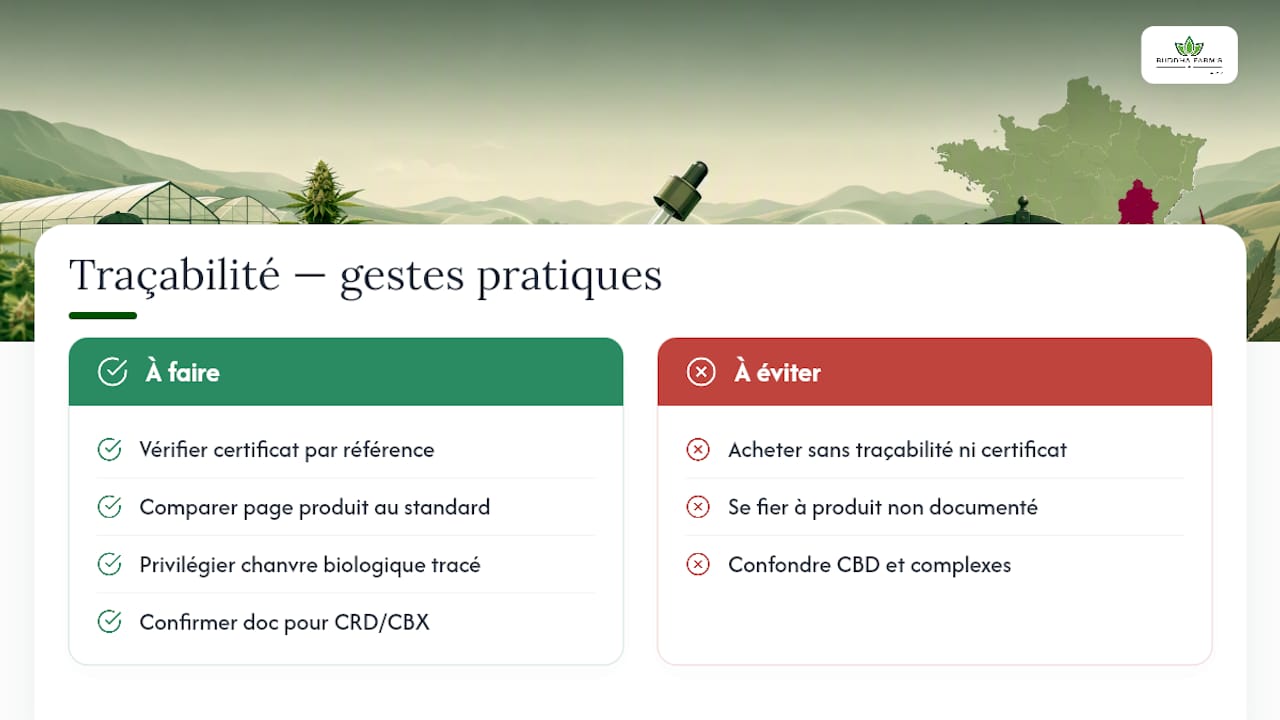
- Check for the existence of a Certificate of Analysis (COA) issued by an independent laboratory, dated and legible, never a simple marketing claim.
- Beware of unfamiliar molecule names or changing abbreviations (HHCPO, THCJD, and similar variants): the vocabulary evolves faster than the law itself.
- Be extra vigilant with the riskiest formats : e-liquids, candies and “enriched” flowers are the most frequent vectors of contamination by spraying, because the molecule added after harvest is distributed unevenly over the product.
- If in doubt, simply abstain or go to a drug-checking service to have the product analyzed.
Pro tip: a batch of flowers contaminated by spraying is never homogeneous. Two buds from the same bag can contain very different concentrations, making any calculation of personal dosage pointless.
What Buddhafarms guarantees regarding the traceability of its products
Buddhafarms works exclusively with organic hemp, and each product has verifiable compliance documentation—a requirement the brand has upheld since 2018. This rigorous approach applies to both flowers and extracts, based on a simple principle: never a product without clear traceability and a consultable certificate. For a reader new to identifying a suspicious product, the best practical application is to systematically compare product pages to this standard, keeping in mind that the brand clearly distinguishes its compliant CBD ranges from its innovative complexes like CRD or CBX, each documented separately.
What regulation will change for the market
The proliferation of classifications based on chemical nuclei will inevitably lead to the removal of some non-compliant products from the French market. However, individual vigilance remains essential: the law is always playing catch-up with chemistry, never ahead of it. Independent analyses and public awareness campaigns will remain the best protection until regulations establish a stable and lasting framework.
— Fred
Prioritize traceable CBD products rather than obscure molecules
The brand claims to offer products with a certificate of analysis, based on documented organic hemp.

The brand offers CBD flowers grown indoors, in greenhouses, or outdoors, depending on your preference, as well as CBD oils and CBD extracts for those seeking controlled concentrates. Before making a purchase, it is advisable to check the certificate of analysis available on the product page. The legal CBD sold by the brand is presented as distinct from the prohibited neo-cannabinoids mentioned in this article. To explore the full range, the online store remains the easiest starting point.
Where did the information in this article come from?
The classification decisions cited come from the ANSM for French legality, from infodrog fact sheets for toxicology, and from EUDAfor the European framework and monitoring of uses.
This article provides general information and is not a substitute for professional medical advice. Consult a qualified healthcare professional about your specific situation before taking any action based on this content.
Sources
- Infodrog
- ANSM adds new cannabinoids to the list of narcotics — ANSM
- Administrative conclusion on the classification of cannabinoids — Council of State (case 2025)
- EUDA — resources on legislation and prevalence of use in Europe
Frequently Asked Questions
Which is the best neo-cannabinoid?
There is no single "best" neo-cannabinoid in terms of safety: these molecules remain largely poorly documented and associated with unpredictable risks. The most sensible choice is to favor natural CBD products with a certificate of analysis rather than a recently developed synthetic molecule.
Is THCV banned in France?
THCV, as a natural phytocannabinoid, is not included in the ANSM's recent classifications, unlike semi-synthetic derivatives such as HHC or H4CBD, which are already classified as narcotics. However, the situation remains subject to change with new classification decisions based on chemical nuclei.
What are the effects of cannabichromene?
Cannabichromene (CBC) is a naturally occurring phytocannabinoid found in small amounts in the cannabis plant, generally described as non-psychoactive and with no established link to the severe intoxications observed with synthetic cannabinoids. It should not be confused with the high-risk semi-synthetic molecules discussed in this article.
What are cannabinoids?
Cannabinoids are a family of molecules that interact with the human body's endocannabinoid system, primarily via CB1 and CB2 receptors. Some are natural and derived from the cannabis plant, while others are manufactured in a laboratory—a crucial distinction for assessing their safety and legal status.


