
A roadside saliva test looks for active delta-9-THC, never CBD itself. A legal CBD product (less than 0.3% THC) can therefore, in some cases, detect THC, especially if it consists of smoked or vaporized full-spectrum flowers, resins, or oils. Isolates and broad-spectrum products certified as 0% THC do not normally present this problem. In the event of a positive result, a blood test confirms the result and can trigger criminal proceedings, regardless of the legal status of the product consumed.
In short:
- Only active delta-9-THC and not CBD are detectable by roadside saliva tests, with a threshold set at 0.1 ng/ml in France.
- CBD products with a high concentration of THC, such as full spectrum flowers or resins, present a high risk of a positive test, especially when inhaled.
- The detection time in saliva varies from a few hours to several days depending on the frequency of use and the form of the product consumed.
- French legislation does not distinguish between the legality of CBD and criminal liability in the event of THC detected during a roadside check.
- Purchasing products with a certificate of analysis, certified as 0% THC, reduces the likelihood of a positive result, but does not guarantee the absence of risk.
Table of Contents
- What do roadside saliva tests in France actually detect?
- Which CBD products pose a real risk of testing positive?
- How long does THC remain detectable after taking CBD?
- What are the legal consequences of a positive saliva test in France?
- What should you do if you test positive after consuming CBD?
- How can we concretely reduce the risk of a positive test?
- What a certificate of analysis reveals (and why it matters)
- What I take away from all this
- Where can I find tested and traceable CBD products?
- Sources
- Frequently Asked Questions
What do roadside saliva tests in France actually detect?
Law enforcement agencies use rapid tests, such as DrugWipe strips, which specifically target active delta-9-THC, the psychoactive molecule in cannabis. CBD, however, is not detected by these devices: it is neither sought nor flagged.
In France, the threshold for declaring a saliva test positive is set at 0.1 ng/ml of THC, a level low enough to detect even trace amounts. Once this threshold is exceeded, a blood test is performed to confirm the result in a laboratory, which is the only evidence admissible in court.
Key takeaway: the 0.1 ng/ml saliva threshold leaves little room for error. A residual trace of THC from an improperly dosed CBD product can be enough to exceed the limit.
Saliva, blood, and urine do not tell the same story:
- Saliva detects the active THC present in the mouth, with a short window after consumption.
- Blood measures the same active molecule, which is useful for confirming recent poisoning.
- Urine detects THC-COOH, an inactive metabolite that remains detectable for much longer, without any link to current driving under the influence.
Which CBD products pose a real risk of testing positive?
It all depends on the product's composition and how it's consumed. A full-spectrum product retains all the cannabinoids of hemp, including THC, up to the legal limit of 0.3% . A broad-spectrum product retains several cannabinoids but theoretically eliminates THC. An isolate contains only pure CBD, without any other molecules.
- Smoked or vaporized flowers and resins directly expose the oral mucosa to THC, making them the riskiest category for a saliva test.
- Ingesting full-spectrum oils presents a lower but not zero risk, especially at high repeated doses.
- Properly certified isolates and broad spectrum do not normally present any measurable risk, provided that the stated THC level corresponds to the reality of the product.
The real problem often stems from the labeling. Some manufacturers advertise a THC level that doesn't exactly match what an independent analysis reveals, a discrepancy that can be enough to tip a regular user towards the positive side.
How long does THC remain detectable after taking CBD?
The detection window varies considerably depending on the frequency of consumption and the form of the product. SFTA technical reports show that the salivary window ranges from a few hours for occasional use to several days for regular users.
Key figure: between 1 and 12 hours. This is the typical range for saliva detection according to the frequency of consumption reported by the SFTA, compared to a significantly longer duration in urine.
- Occasional consumption: saliva usually becomes clean again within a few hours.
- Regular consumption: the window often extends over several consecutive days.
- Blood: short detection period, reserved for active THC still in circulation.
- Urine: long detection via THC-COOH, a metabolite with no link to driving status at the time of testing.
Body size, individual metabolism, and method of consumption (smoked, vaporized, ingested) all affect the duration of these effects, which varies from person to person. The bioavailability of the consumed product directly influences the rate at which cannabinoids reach saliva and then disappear from it.
What are the legal consequences of a positive saliva test in France?
French law applies a zero-tolerance policy for THC while driving. There is no tolerance threshold for "reasonable" use: the mere presence of active THC above the detection threshold constitutes an offense, governed by regulations on drug testing.
The Court of Cassation has definitively ruled on this issue: the legal sale of a CBD product containing up to 0.3% THC does not exempt a driver from criminal liability if THC is detected in their system, according to a decision by the highest court. In other words, the legality of the purchased product has never protected anyone from prosecution on the road.
The procedure always follows the same pattern:
- Roadside check and saliva test carried out on site by law enforcement.
- In the event of a positive result, a confirmatory blood sample is the only admissible evidence.
- Possible criminal prosecution: fine, points deduction, license suspension or cancellation, or even prison sentence in case of repeat offense or accident.
A written question submitted to the National Assembly challenged the government on this very real risk for consumers of perfectly legal CBD products, demonstrating that the issue goes beyond a simple debate among users. To contest a result, one must consult Légifrance and the regulations concerning testing, the only solid basis for building a defense.
What should you do if you test positive after consuming CBD?
A positive test does not automatically mean a conviction, but the margin for maneuver often lies in the first few minutes.
- Stay calm and always request confirmation by blood test, your most basic right in the face of a positive saliva test.
- Keep the receipt or invoice for the CBD product consumed, along with its purchase date, in a safe place.
- Obtain the Certificate of Analysis (COA) for the product in question from the seller, if you do not already have it.
- Consult a lawyer specializing in traffic law as soon as possible to assess your options, especially if the measured rate is close to the legal threshold.
Pro tip: Take a photo of the product label and batch number before consuming it. In case of inspection, this simple step can save valuable time in finding the corresponding certificate of analysis.
How can we concretely reduce the risk of a positive test?
Choosing the right product is just as important as driving behavior. A few simple adjustments can significantly reduce THC exposure.
- Opt for isolates or broad spectrum certified 0% THC rather than full spectrum flowers or resins.
- Always demand a Certificate of Analysis (COA) issued by a third-party laboratory independent of the manufacturer.
- Avoid consuming flowers, resins or vaping in the hours before driving, as these forms directly expose saliva to THC.
- Moderate the doses of oil, even full spectrum, because accumulation over several doses increases the residual THC present in the body.
Pro tip: Keep a digital copy of every Certificate of Authenticity (COA) you receive. Presenting it immediately during an inspection demonstrates your good faith and greatly facilitates any potential dispute.
What a certificate of analysis reveals (and why it matters)
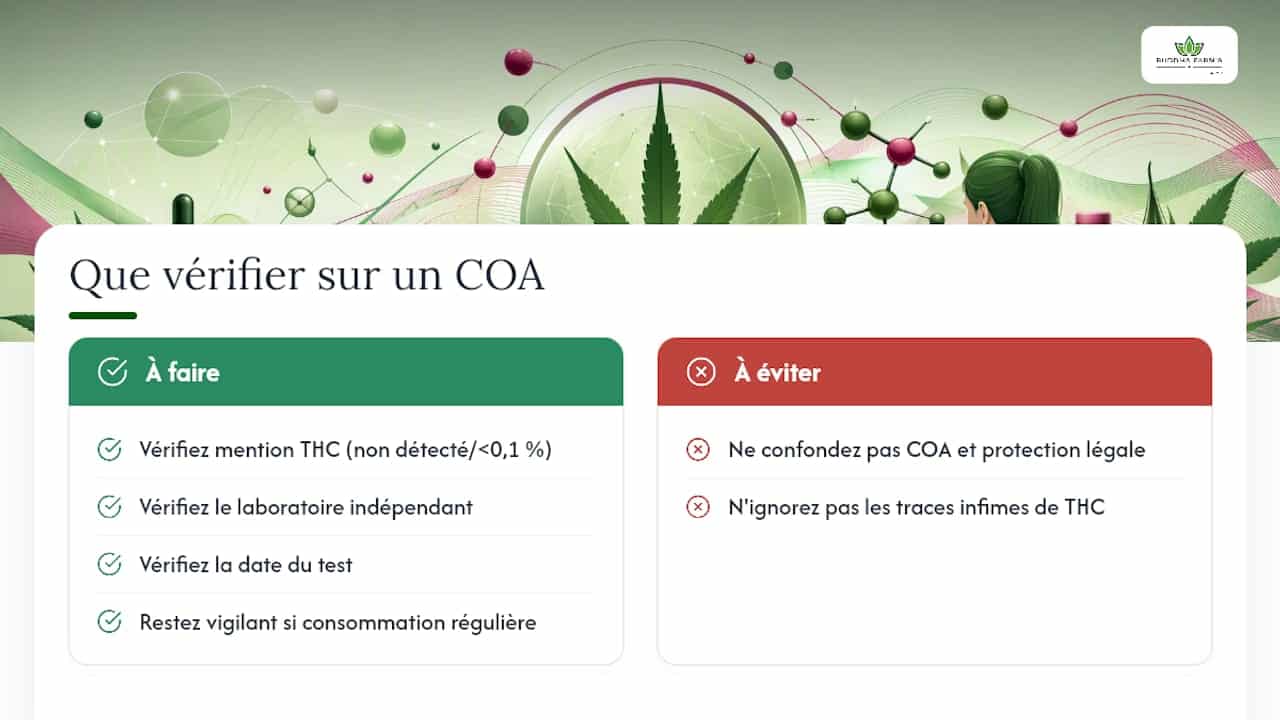
Some sellers offer products accompanied by traceability and certificates of analysis (COA), a useful resource to verify what a CBD product actually contains, but which in no way constitutes a legal guarantee against a roadside check.
On a reputable Certificate of Analysis (COA), look for an explicit statement of the detected THC level (ideally “not detected” or less than 0.1%), the name of the independent laboratory that performed the analysis, and the date of the test. Even a certified product can contain trace amounts of THC: vigilance is still essential, especially with regular consumption.
What I take away from all this
The responsibility remains entirely with the driver, regardless of the legality of the product purchased. I also expect greater transparency from sellers regarding the actual THC levels. My advice: opt for products that have been lab-tested and avoid consuming any substances before driving.
— Fred
Where can I find tested and traceable CBD products?
Buddhafarms focuses on a selection of organic hemp, with rigorous traceability designed for consumers who want to know exactly what they are buying, rather than guessing an approximate THC level on a generic label.

A properly certified isolate or broad-spectrum product significantly reduces the risk of a positive saliva test, but no certification replaces the law: a roadside check is always possible, and caution is better than blind trust. If you want to see a product's Certificate of Analysis (COA) before buying it, request it directly from the seller's customer service. Browse the selection of CBD flowers or oils available, and request the corresponding COA before placing any order.
Sources
To learn more, consult Drogues Info Service, the texts of Légifrance on roadside screening, the SFTA report on saliva and driving, as well as the legal analysis of KL Avocats on CBD and driving.
This article provides general information and is not a substitute for legal advice. Consult a qualified legal professional regarding your specific situation before taking any action based on this content.
- SFTA — Drugs, saliva and driving. State of knowledge (2022)
- CBD and screening tests: saliva, urine, blood (2026) – Newsweed
- Relevant legislative texts (Legifrance)
Frequently Asked Questions
How does the police know if it's CBD or THC?
She doesn't know for sure on the spot: the roadside saliva test doesn't differentiate between the two molecules; it only detects the presence of active THC. Only a blood test in a laboratory can then precisely confirm the detected level.
Is it safe to smoke CBD and then drive?
Smoking CBD flowers or resins directly exposes saliva to the active THC they contain, even in small amounts, making driving immediately afterward risky. It's best to wait several hours or opt for a THC-free isolate before getting behind the wheel.
Can CBD be detected by the police in a saliva test?
No, the saliva test does not look for CBD itself; it targets only delta-9-THC. Therefore, a pure CBD product, without any trace of THC, cannot trigger a positive result.
How long after a positive CBD consumption can one drive?
This depends on the frequency of consumption: the saliva detection window generally ranges from a few hours for occasional use to several days for regular use, according to SFTA data.


